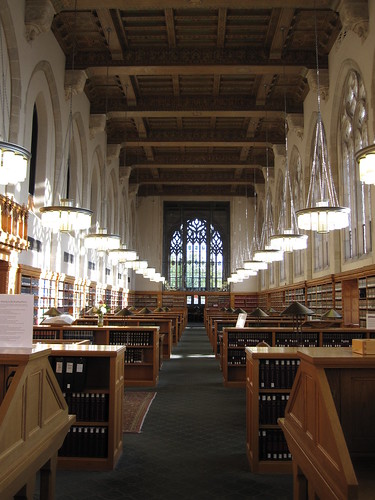
Sterling Law Building, Yale University (1931)

Designed by James Gamble Rogers and built in 1930-1931 at 127 Wall Street in New Haven, the Sterling Law Building is the building of Yale Law School. Modeled on the English Inns of Court, it features a great variety of Gothic architectural detailing. Rising impressively above the rest of the structure, with its rows of Gothic windows, is the Lillian Goldman Law Library. The Sterling Law Building, which occupies one city block, was named for John William Sterling, a corporate attorney and major benefactor to Yale University.

Noah Webster School, Hartford (1900)

The Noah Webster School is an elementary school on Whitney Street in Hartford’s West End. It was named for the famous lexicographer, textbook pioneer, English spelling reformer, political writer, editor, and prolific author, Noah Webster, who was born in West Hartford. The school was designed in the Tudor Revival style by architect William C. Brocklesby. Additions were made to the building in 1906 and 1909 by Brocklesby & Smith, in 1932 by Malmfeldt, Adams & Prentice, and most recently by DuBose Associates as the school was converted into a “MicroSociety Magnet School.”

Lewis Rowell House (1851)

In 1851, local joiner Lewis Rowell built as his residence the brick house at 25 Lewis Street (a street renamed in his honor in 1883). The house has a 1926 addition by architects Smith & Bassette, projecting out to the sidewalk. Lewis built the adjoining house, at 27 Lewis Street, in 1855 as a mirror image to his own house. He purchased the house at 30 Lewis Street as a wedding present for his daughter, Mary Rowell Storrs, in 1874. She later lived in an 1899 house on Farmington Avenue.

Masonic Temple, Hartford (1894)

The corner stone of the former Masonic Temple at 199-203 Ann Street in Hartford was laid on September 22, 1894. The completed building was first opened for lodge meetings in September, 1895 and the building was officially dedicated on July 14, 1896. Displaying a variety of Masonic symbols, it was designed by architect Brooks M. Lincoln of Hartford (1852-1898). No longer used as a Masonic hall, the building was converted into offices in 1982 and its original stained glass windows have been replaced with clear glass.

Copper Hill United Methodist Church (1839)

Copper Hill United Methodist Church is located at 27 Copper Hill Road in East Granby. As related by Charles Horace Clarke in The Memorial History of Hartford County:

The Methodist church at Copper Hill was built in 1839, and in 1850 was thoroughly repaired, and moved about five rods westward. Like all Methodist churches, it has had regular changes of pastor. In the ministry of Lemuel Richardson, in 1871, there was an extensive revival of religion, attended with remarkable manifestations. The writer, at a single evening meeting in the church, which lasted from seven o’clock until midnight, witnessed as many as fifteen persons who became apparently unconscious. Some were stretched upon the floor; others were lying or being supported upon the seats. This visitation of “the Spirit” was regarded as a great blessing, and it certainly did strengthen the church in numbers. Mr. Richardson was a large, powerful man, full of strength, zeal, and boldness, and possessed of a strong, loud voice, which he used in singing as well as in preaching and prayer.