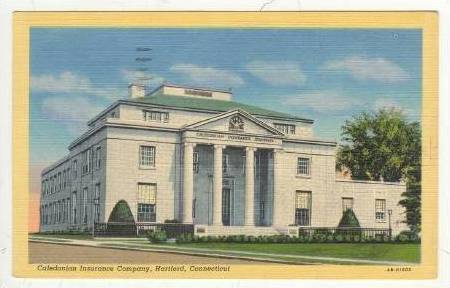
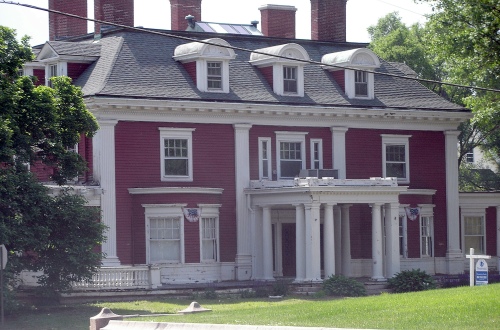
Southern New England Telephone Company Building, Hartford (1931)

Facing Bushnell Park at 55 Jewell (now 55 Trumbull) Street in Hartford is the Southern New England Telephone Company Building, built in 1930-1931. The Art Deco structure, designed by R.W. Foote, emphasizes linear compositions with geometrical ornamentation. The building was expanded in 1953 with the addition of the upper six floors, an enlargement that had been planned for in the original design. SNET relocated in the 1970s and the building was leased to other tenants, eventually becoming wholly vacant. In recent years, it has been converted into apartments and is known as “55 On the Park.”

Orrin Todd House (1815)

The house at 3369 Whitney Avenue in Hamden was built around 1815 by Orrin Todd, the son of local builder Simeon Todd. The house was originally located on the opposite side of the road, until the Farmington Canal was laid out to pass through Todd’s land. He sold his property to the Farmington Canal Company and moved to Ohio. The house was then moved to its current site by Butler Sackett, a businessman who also purchased and moved other houses along the canal route. In the later nineteenth century, a general store was attached to the house.

Charles Phelps House (1905)

Charles Phelps (1852-1940) of Rockville was a lawyer who served as Tolland County coroner (1883-1904) and state’s attorney for Tolland County (1904-1915). He was also corporation counsel and prosecuting attorney for the city of Rockville. In politics, he served as a state representative and state senator and then as Connecticut’s Secretary of State (1897-1899), resigning to became the state’s first attorney-general. Charles Phelps‘ 1905 Georgian Revival house at 1 Ellington Avenue in Rockville was designed by Hartwell, Richardson & Driver of Boston. While the house has recently been in need of rehabilitation, the carriage barn in the rear has been used for housing.

Russell Hubbard House (1826)

The Russell Hubbard House, at 161 Broadway in Norwich, was built in 1826. Its second-story glassed-in porch and front entry-porch are later additions. Russell Hubbard‘s father Thomas Hubbard, was the first publisher of the Norwich Courier. As related in The American Journal of Education, Vol. 5, No. 13 (June, 1858), edited by Henry Barnard:

Russell, on attaining his majority, became a partner with his father in the publication of the Courier, and in 1808, on the death of his father, became sole proprietor of the Courier, which he continued to publish until April, 1822. He also carried on a general business in bookselling and publishing, in connection with the publication of his paper; and, engaged, to a limited extent, in the manufacture of paper. In 1822 this last mentioned department of his business seemed to claim his exclusive attention, and he accordingly relinquished his interest in publishing and bookselling, and continued actively engaged in the manufacture of paper for fifteen years. In 1837, he listened to a proposition from his brother, Amos Hallam Hubbard, who was engaged in the same business, for the formation of a partnership, and thus originated the well known firm of R. & A. H. Hubbard, which continued, until it was terminated by the death of the senior partner, on the 7th of June, 1857. […]

No sooner did he come into the possession of ample means, than he began to devise means of more extended usefulness. He was a liberal contributor to the various benevolent enterprises of the age; but, aside from these, cherished a desire to aid in the establishment, in his native city, of an institution of learning, which should afford to coming generations advantages superior to those which were engaged in his childhood. Prompted by this desire, he become an efficient counselor, and one of the most liberal contributors in the establishment of the Norwich Free Academy.

Quoting the History of Norwich (1866), by

Mr. Russell Hubbard was an early and efficient patron of the Free Academy, contributing about $11,000 towards its establishment. He was one of the trustees to manage the funds and erect buildings, and the first president of the board. The Hubbard Rhetorical Society, connected with the Academy, perpetuates his name.

Middlebury Congregational Church (1935)

The Congregational Church in Middlebury dates back to 1791 and the first meetinghouse was built in 1794 on the town Green. The steps, built of stone quarried in Roxbury, and the church bell, cast in Troy, New York, were reused in the second meetinghouse, built in 1839. On April 8, 1935, the church and the neighboring town hall were destroyed in a fire. The bell was shattered but the pieces were recast to make a new bell. A new church was built in 1935-1936 as a replica of the destroyed second meetinghouse. Additions were made to expand the church in later years.

Judd & Root Building (1883)

Henry C. Judd and Judson H. Root were successful wool merchants in the later nineteenth century. The firm of Judd & Root, formed in 1869, built an office building at 179 Allyn Street in Hartford in 1883. The architects were Francis H. Kimball and Thomas Wisedell, who also designed the Goodwin Building in Hartford. Unlike that earlier Queen Anne structure, the Judd & Root Building was constructed in the Romanesque Revival style, although both buildings feature terra-cotta decoration on the upper floors. The Judd & Root Building also has a brick Renaissance Revival-style arcade on the first floor, where retail shops were located. It became known as Professional Building in the 1920s, when the ground floor housed a pharmacy and a surgical supply company and over 50 physicians and surgeons had offices above. The building was restored around 2001. (more…)