Edward K. Nicholson House (1915)

The house at 754 Clinton Avenue in Bridgeport was built in 1915 for Edward K. Nicholson. According to the History of Bridgeport and Vicinity, Vol. II (1917):

Edward K. Nicholson, a member of the Bridgeport bar since January, 1900, and practicing since 1912 as a partner in the firm of Banks & Nicholson, entered upon his professional career well equipped by a thorough university training for the responsible duties which he assumed. He was born in Essex, Connecticut, in 1872, a son of the Rev. George W. Nicholson, who in 1894 removed with his family to Bridgeport to accept the pastorate of the First Baptist church […]

After acquiring a thorough preliminary education Edward K. Nicholson entered Yale and completed the academic course by graduation with the class of 1896. Four years later his alma mater conferred upon him the degree of Doctor of Philosophy. In the meantime he took up the study of law and in January, 1900, was admitted to the bar in Fairfield county. He opened an office in Bridgeport and for six months continued alone in practice, at the end of which time he joined Samuel E. Shaw in organizing the firm of Shaw & Nicholson, a relation that was maintained until 1909, after which Mr. Nicholson practiced alone until the present firm of Banks & Nicholson was formed in 1912. In the years of his practice he has been accorded a large and distinctively representative clientage and in the trial of many cases has proven his ability to successfully cope with intricate and involved legal problems. For two years he served as deputy judge of the city court of Bridgeport. In April, 1917, Mr. Nicholson was elected president of the Fairfield County Association for the Mobilization of Resources.

In December, 1900, Mr. Nicholson was married to Miss Mary L. Thomas, of Saratoga Springs, New York, and they have three children, Sylvia T., Edward K. and Miriam E.

Mather Homestead (1840)

The Mather Homestead is a former Greek Revival farmhouse in Hartford’s North End, built sometime between 1835 and 1843. Changes to the house over the years illustrate the many demographic changes that have occurred in the surrounding neighborhood. The house was constructed by William Mather, a prosperous Yankee farmer, and continued as a residence until 1926. The house faces Mahl Avenue (the address is 2 Mahl Avenue), but originally had a Main Street address, because Mahl Avenue was not opened until 1893. At that time, developer Frederick Mahl bought the Mather farm and subdivided it. Starting in 1887, the Mather house was rented by Charles Skinner, an insurance clerk, who bought the house in 1898. In 1916, the Skinner family sold the house to a Jewish family.

Significant structural changes began for the Mather Homestead in 1926, when it was converted for use as a synagogue. The alterations were undertaken by two Orthodox congregations, Teferes Israel and Chevre Kadishe, which had merged in 1926. Both congregations had been founded by Russian immigrants: members of Teferes Israel came from Ludmir (now in Ukraine) and members of Chevre Kadishe from Wolkowysk (now in Belarus). Among other changes, a rounded projection on the east (Main Street) side of the building was added for an ark to hold Torah scrolls. The Mahl Street side of the building originally had a Greek Revival columned porch on the first floor and a second porch was added above it on the second floor in 1926. Known as the Mahl Avenue Shul, Teferes Israel later moved to Bloomfield and, in 1993, merged with Beth David in West Hartford.

In 1954, the building was acquired by an African American Masonic Temple, Excelsior Lodge No. 3. Founded in 1856 by a group of Prince Hall Masons, Excelsior Lodge has included among its members many leaders of Hartford’s black community. For many decades, the exterior was left unaltered, but the columned porches have since been removed and replaced by an enclosed entry addition on the fist-floor.

Robert Schutz House (1907)

Prospect Avenue forms a border between Hartford and West Hartford. My new book, A Guide to Historic Hartford, Connecticut, features some interesting houses on the West Hartford side of the street, including the Robert Schutz House at 1075 Prospect Avenue. Unlike other residences nearby, this house is turned 90 degrees from the street. Built in 1907 and designed by Charles Adams Platt, the house was built for Robert Schutz, president of the Smyth Manufacturing Company, which still makes bookbinding machines today. The house was also the residence of his son, Robert Schutz Jr., who was an architect. As a trustee and president of the Mark Twain Memorial in the 1950s, Robert Schutz Jr. donated objects he found in the attic of this house to what is now the Mark Twain House and Museum.

Emanuel Lutheran Church, Hartford (1924)

And yet another church in Hartford founded by Scandinavian immigrants is Emanuel Lutheran Church, founded in Frog Hollow in 1889 as the Swedish Evangelical Lutheran Emanuel Church (Svenska Evangelisk Lutherska Emanuelförsamlingen). The church’s first building, built in 1892 at the corner of Babcock and Russ Streets, is now the George J. Rau-Arthur F. Locke Post 8 of the American Legion. In 1913, the basement of a new church on Capitol Avenue was finished and the first services in the completed structure were held in 1924.

Our Saviour’s Danish Evangelical Lutheran Church (1891)

Another Scandinavian church in Frog Hollow in Hartford was built in 1891 at the corner of Russ Street and Babcock Street. Our Saviour’s Danish Evangelical Lutheran Church was organized in 1883, making it the oldest Lutheran Church in continuous existence in the Hartford area. It was located in Frog Hollow until the 1950s, when the congregation moved to West Hartford Road in Newington. In 1967, the church merged with Holy Trinity Lutheran Church, which had been founded by Swedish immigrants in 1945. The church, unified under the name Our Savior’s Lutheran Church, is located at 1655 Main Street in Newington. The old church building in Hartford is now home to Iglesia Adventista Del 7mo Dia.

Swedish Zion Congregational Church (1892)

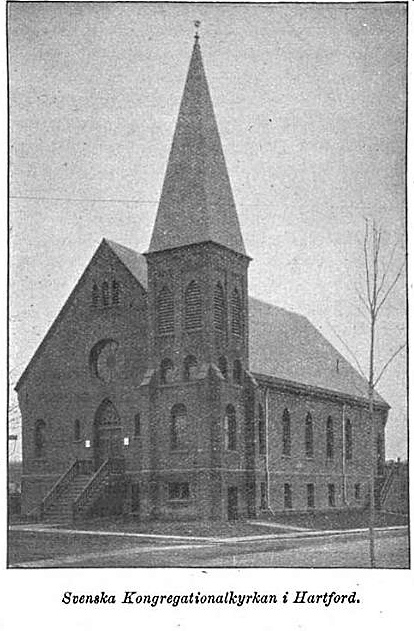
Over a century ago, Hartford’s Frog Hollow neighborhood was home to a significant Scandinavian immigrant community. A number of churches were established at the time. I’ve previously featured the Swedish Bethel Baptist Church on this site (it’s also mentioned in Tour 9 in my new book, A Guide to Historic Hartford, Connecticut). Nearby, at 87 Russ Street, at the corner of Hungerford Street, is another church built by a group of Swedes. In 1883, Rev. C. J. Erixon, a home missionary for the Congregational Church, began preaching to Swedish immigrants in Hartford. The group became known as the Swedish Evangelical Free Church. In 1889, L. W. A. Bjorkman became the first permanent pastor and the congregation took a new name, the Swedish Evangelical Zion Church (Svenska Evangeliska Zion-kongregationalförsamlingen i Hartford), also known as the Swedish Zion Congregational Church. In 1890, the church became part of the local branch of the Evangelical Covenant Church, which was largely a Swedish denomination at the time. From 1892 to 1960, the church was located at the building in Frog Hollow. In 1938, the church changed its name to the Covenant Congregational Church and in 1960 the church moved to West Hartford, where most of its membership resided. The Hartford church building was sold to the Hartford Full Gospel Church (the address is now 77 Hungerford Street).

Linus B. Plimpton House (1884)

Designed by architect John C. Mead and built in 1884, the Romanesque-style Linus B. Plimpton House is located at 847 Asylum Street in the Asylum Hill neighborhood of Hartford. In 1865, Linus B. Plimpton (who was originally from Southridge, MA) established a business in Hartford manufacturing envelopes. The Plimpton Manufacturing Company won an important contract in 1874 to produce stamped envelops for the U.S. government. The prize was awarded by Postmaster General Marshall Jewell, a Hartford resident and former governor of Connecticut. The modern descendant of the old manufacturing firm continues to exist as Plimpton’s, a stationery retail store in West Hartford Center. The old Plimpton House on Asylum Avenue is now used for elderly housing. For further reading on the Plimpton Manufacturing Company, see the following pdf files: The History of Envelopes and “A Specialized Study of the Plimpton Manufacturing Co., Hartford, Connecticut High Value U.S. Postal Stationer.”