Talcott-Hollister House (1851)

Talcott-Hollister House, Glastonbury

Various dates have been given for the Federal/Greek Revival house at 2146 Main Street in Glastonbury. Some claim 1780, while the Historical Society of Glastonbury records give 1850/1851. Notable for its tin roof, it is known as the Talcott-Hollister House. Replacing an earlier Talcott Homestead, torn down in 1850, it was built the following year by Jared Talcott. It was next home to his son, Capt. Charles H. Talcott, and later to Charles‘ daughter Charlotte and her husband, Norman E. Hollister (1845-1923).

Bailey-Sibley House (1860)

Bailey-Sibley House

The former residence at 208 High Street in Middletown was built sometime between 1859 and 1870. Its original appearance was in a different architectural style. It was a cross gabled building with projecting eaves and a Victorian porch. A one-story wing (later raised to two stories) was added to the rear in 1876. The brick house was built on a tract of land developed by Israel Bailey and was a rental property until 1892, when Jennie A. Bailey Sibley and her husband, Howard A. Sibley, acquired title to the property from other heirs of Israel Bailey. The house was altered early in the twentieth century when the current entrance porch and a classical pediment and cornice with modillions were added. The Sibleys occupied the house until 1920. The following year, it was acquired by Wesleyan University for use as housing. It is now Wesleyan’s Office of Public Safety.

Jesse Hart House (1800)

203 Hudson St., Berlin

Jesse Hart was a cabinet-maker, tavern-keeper and postmaster in Berlin. His brick house, at 203 Hudson Street, was built c.1800. It has chimneys at each of its four corners, with corresponding fireplaces inside. In 1813, he purchased the tavern at Boston Corners and became its landlord. As related in Catharine Melinda North’s History of Berlin (1916):

Jesse Hart, born 1768, married 1792, was a cabinet maker. Before he kept the hotel, at Boston Corners, he lived in the brick house, now owned by Leon LeClair. It is probable that he built that house. His first wife, Lucy Beckley, died in 1814 and, in 1822, he married, second, Mindwell Porter, daughter of Samuel Porter. Mr. Hart died in 1827, aged fifty-nine. Mrs. Hart survived him forty-eight years, and died July 6, 1875, aged ninety-one.

Hart was the half brother of Emma Hart Willard, a famous educator who began teaching in Berlin and later founded a school for girls in Troy, New York, that is now the Emma Willard School.

Holy Trinity Episcopal Church, Enfield (1863)

Holy Trinity Church

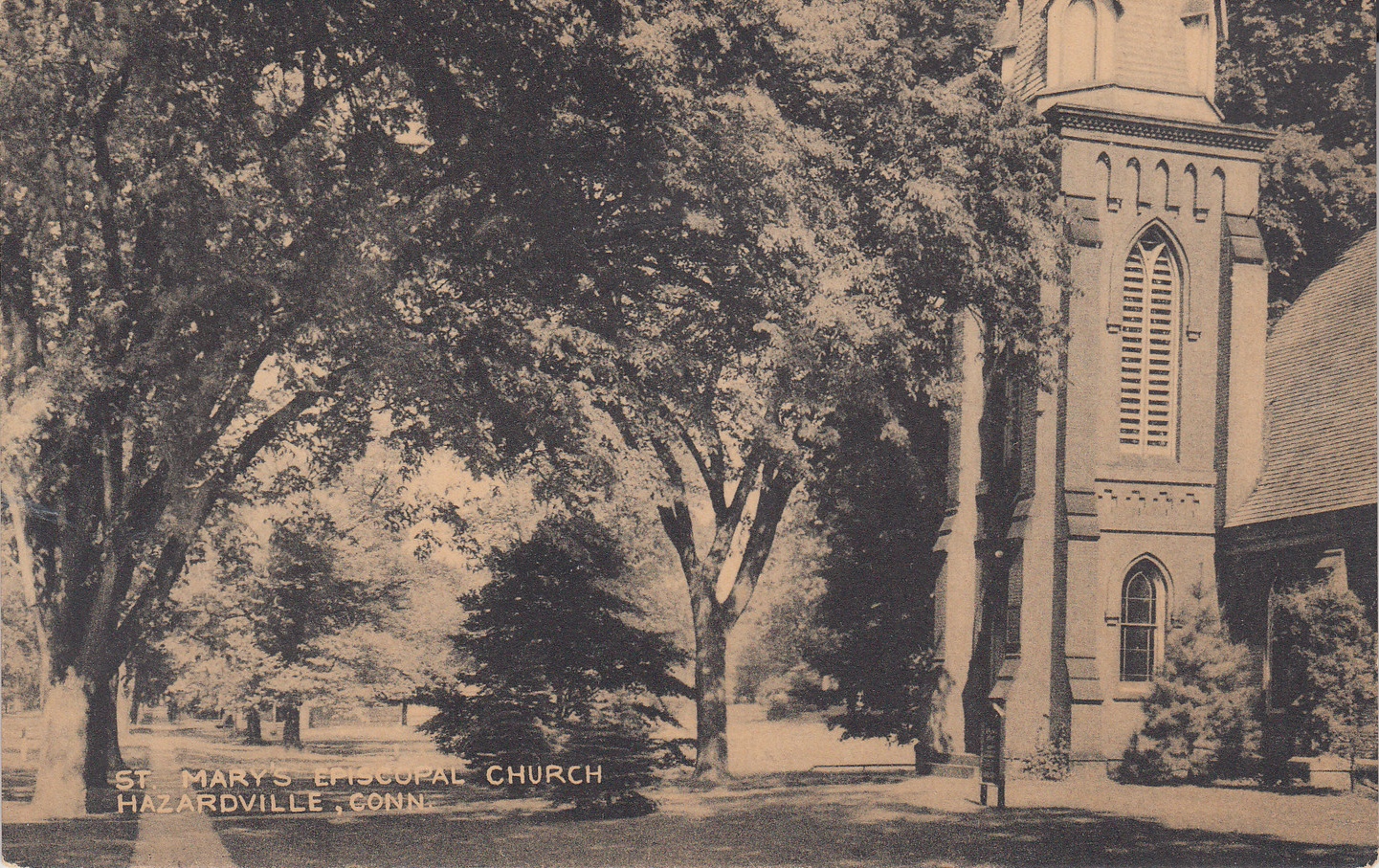
The church at 383 Hazard Avenue in Hazardville in Enfield was built as St. Mary’s Episcopal Church in 1863. Its erection was funded by Colonel Augustus G. Hazard, the gunpowder manufacturer who had founded Hazardville. In 1992, three Episcopal parishes, St. Mary’s Church, St. Andrew’s Episcopal Church in Thompsonville and Calvary Episcopal Church of Suffield, began cooperating as a regional ministry of parishes. In 2007, the three parishes merged to form Holy Trinity Episcopal Church, whose home is the former St. Mary’s Church.

Goodwin Schoolhouse (1821)

Goodwin One Room Schoolhouse, East Hartford

The Goodwin Schoolhouse in East Hartford was built in 1821 by George Goodwin, Jr., a paper manufacturer. He built the school on his own property on Burnside Avenue and hired a teacher to teach his own children and those of his neighbors. A one room schoolhouse, the building was used as a school until 1855, when the students started attending town schools. The former school was moved to Martin Park in 1975 as a gift to the town from George Goodwin, grandson of the original builder. It is open as a museum operated by the Historical Society of East Hartford.