The Greek Revival house at 585 Main Street in Portland was built in the 1840s (possibly 1847). It was originally the home of Stephen H. White. This may be the Stephen H. White, son of George White, who is described in the Memorials of Elder John White (1860), by Allyn S. Kellogg, page 206 as
born in Portland, Dec. 15, 1820. He resides there, and is a farmer and carpenter.
He married twice, first in 1844 to Sarah Risley of Glastonbury (died 1846); second in 1850 to Almira W. Ufford of Portland.
The house at 15 Pearl Street in Middletown was built in either 1838 or 1839, at a time when the street was experiencing development as a neighborhood for the urban middleclass of tradespeople and small business owners. It was erected by George E. Barrows, who had a joiner’s shop on the property and may have contributed his skills to the construction. From 1851 to 1883, it was the home of Charles H. Pelton, a printer who had worked with Horace Greeley in New York. The house remained in the Pelton family until 1915.
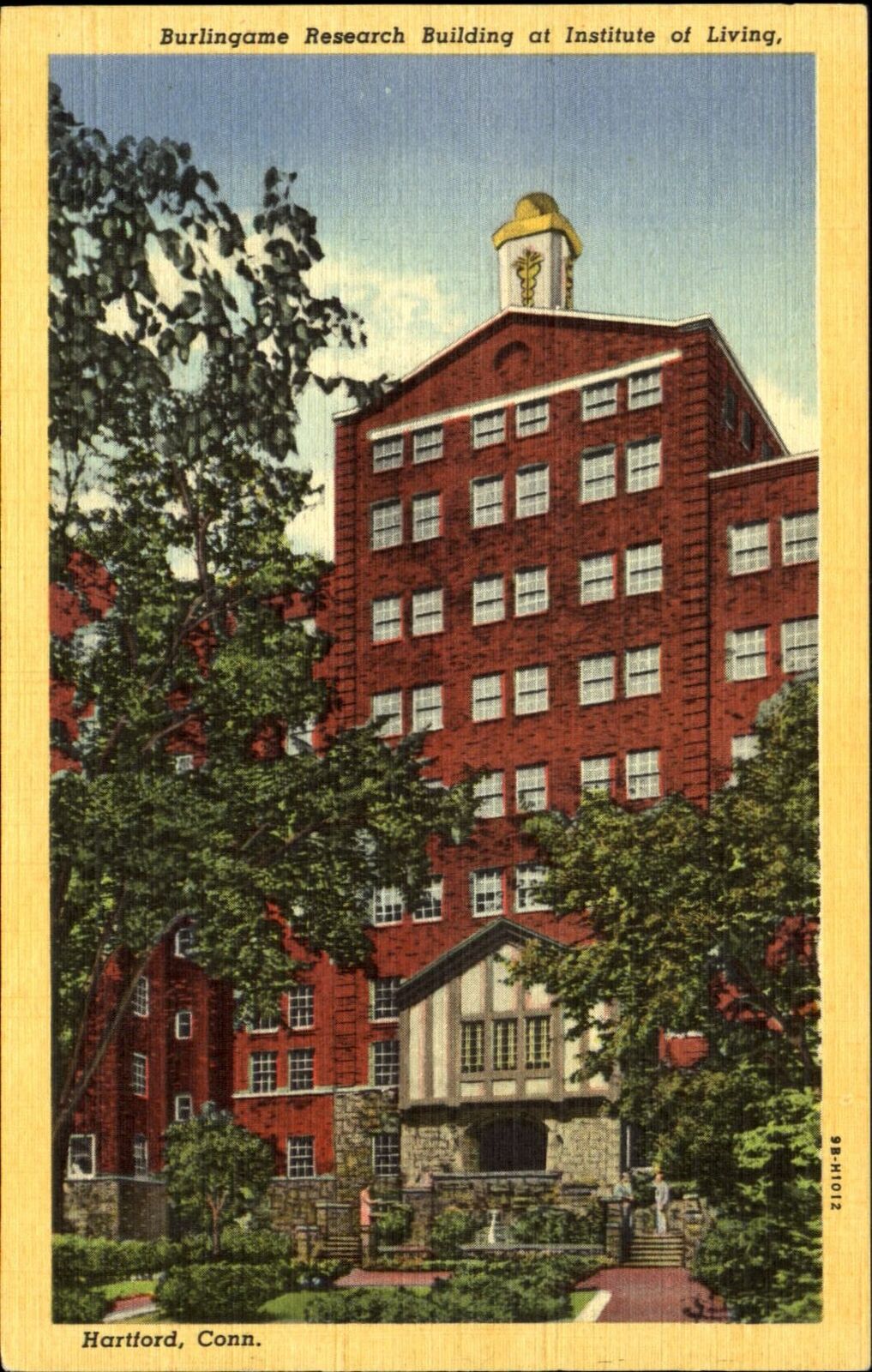
One of the buildings on the campus of the Institute of Living (originally chartered in 1822 as the Retreat for the Insane) in Hartford is the Burlingame Research Building. Erected in 1948, the eight-story building was designed by architect Irving W. Rutherford and was named for Dr. C. Charles Burlingame (1885-1950), who was superintendent of the institution in the 1930s-40s. Atop the building is a tower that displays the symbol of the Caduceus on four sides and is crowned by a golden dome. The tower was lit at night because it was directly in line with runways at Brainard Field (see “Dome Atop Burlingame Building Completed At Institute Of Living,” Hartford Courant, November 25, 1948). The following year a connected eight-story part of the building, called the Psycho-Surgery Building, was opened. (see “Psycho-Surgery Plant Now In Use At Institute,” Hartford Courant, April 17, 1949). Here lobotomies were performed until the 1960s. The operating room was on the sixth floor and the fifth floor was the infirmary for care of immediate post-operative patients. The fourth floor was described in the Hartford Courant (in the 1949 article referenced above) as “unique in the hospital world.” It contained classrooms for retraining those who had been operated on, including social, vocational and recreational development. Subjects included home economics, commercial art, and accounting. Today the Institute is part of Hartford Hospital and the Burlingame Building contains a library and offices.
Located at the intersection of Platt Hill and Taylor Brook Roads in Winchester is a one-room schoolhouse built in 1815 to replace an earlier one on the same site that had burned down in the 1790s. The new building, Winchester’s District No. 8 schoolhouse, was heated by a fireplace until a box stove was installed in the 1830s. The schoolhouse was in use until it closed in 1908. It then remained abandoned for the next eight years. In 1916, William H. Hall, a historian for whom Hall High School in West Hartford is named, expressed his concern for the neglected building in an article Winsted Evening Citizen. This inspired Clifford Bristol to buy and repair the building. Bristol had been a student at the school about 1870 and his father, Charles A. Bristol, had been a teacher there. In June of 1916, Bristol held a reunion in the school of former teachers and students. In 1923 another meeting was held in the building which formed the Little Red Schoolhouse Association, dedicated to preserving the historic building. The organization’s membership had dwindled by the early 2000s, but in recent years there has been renewed interest and fundraising efforts to allow restoration of the building to its original condition. The restored schoolhouse reopened to the public in 2018. Other Connecticut buildings called “The Little Red Schoolhouse” can be found in North Branford (built 1805) and Wethersfield (built 1869).Bristol held a reunion in the school of former teachers and students. In 1923 another meeting was held in the building which formed the Little Red Schoolhouse Association, dedicated to preserving the historic building. The organization’s membership had dwindled by the early 2000s, but in recent years there has been renewed interest and fundraising efforts to allow restoration of the building to its original condition. The restored schoolhouse reopened to the public in 2018.
The house at 140 Burrows Hill Road in Hebron was built c. 1735–1744 by a Mr. Porter. It was purchased by the Smith family in 1794 and remained in that family until 2009. Nathan Smith, the second Smith to live in the home, remarried at age 65. In 1853, he added the Greek Revival north ell, where his father lived after retiring from farming. It is one of three additions that have been made to the house’s north side. There is also a kitchen addition at the rear of the house.
The Smith farm grew to hundreds of acres and included Prophet’s Rock, the town’s oldest historic landmark. The legend of Prophet’s Rock is related by Gov. John S. Peters in his “Historical Notes,” written in 1843 and quoted by F.C. Bissell in Hebron, Connecticut Bicentennial (1908). A group of men from Windsor had set out to explore and find places to settle in the area.
While the men were making preparations for their families in the summer of 1706 they brought their provisions with them and remained for weeks at their new home. Their wives being anxious for the welfare of their husbands and unwilling to be left too long alone, four or five started one shining morning for the promised land, twenty long miles through the wilderness, regulating their course by marked trees and crossing the streams on logs felled for that purpose. Night overtook them in the lower part of Gilead, they wandered from the line and brought up on the hill south of Nathan Smith’s house. Fearing the wolves would regale themselves upon their delicious bodies they concluded to roost upon the top of the high rock on the summit of said hill. Here they proclaimed their lamentations to the winds. This novel serenade attracted the attention of their husbands, who wandered towards the sound until they fortunately but unexpectedly found their wives on the rock, which they had chosen for their night’s repose. The gratification of the interview can be better imagined than expressed.
The location of this rock has been handed down to the present time and it is now known as “Prophet’s Rock.”
At the beginning of the nineteenth century, Ebenezer Jesup (1767-1851) was a resident of the Green’s Farms section of what is now the Town of Westport. Jesup was a grain dealer whose ships traded with Boston and other ports. Because his wharf and warehouses were along the Saugatuck River, he decided to build a home closer to his place of business. About 1807-1810, he erected a house that was considered to be the finest mansion in Fairfield County at the time. The community of Saugatuck would continue to develop, becoming the commercial center of Westport, which was incorporated as a town in 1835. In 1884, Ebenezer’s grandson, Morris K. Jesup (1830-1908), gave the house and eight acres of land to the Saugatuck Congregational Church, which was then located across the Post Road. He stipulated that the property was to be used as a parsonage and site of a future meeting house. In 1950, the Saugatuck Congregational Church’s meeting house, originally built in 1832, was moved onto the donated Jesup property. The Jesup (or Jessup) House, still used by the congregation today, is considered a great example of Federal style architecture. The house was photographed in the 1930s for the Historic American Buildings Survey. Photographs and measured drawings can also be found in The Architectural Forum, Vol. 33, No. 6 (December, 1920).


You must be logged in to post a comment.