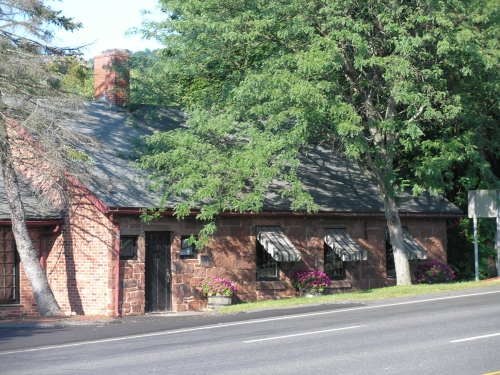
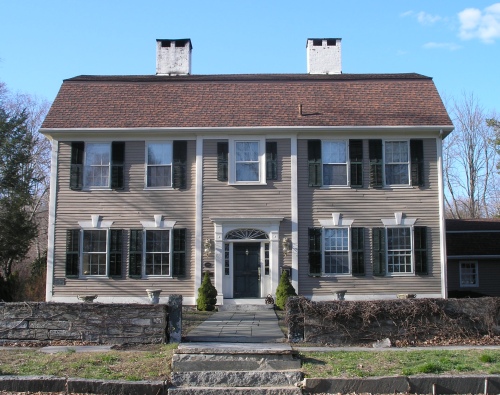
Avon Old Farms Inn (1757)

avon-old-farms.jpg

The oldest section of what is now the Avon Old Farms Inn, at the intersection of Routes 10 and 44 in Avon, is a house built by Nathaniel North in 1757, on land which had been granted to his father, Thomas North, after his service in King Phillip’s War. Thomas’ father, John North, had arrived in the vicinity of Northington (the north part of Farmington, now Avon) in the 1630s. The house was later owned by Nathaniel North‘s great-grandson, John North, a blacksmith who added the 1832 stone blacksmith shop, which is now connected to the house. Across Route 44, once stood Marshall Tavern, a former stagecoach stop, which was demolished in 1933 to improve traffic safety at the intersection. The North House was also used to accommodate travelers, becoming the Old Farms Inn in 1923.

The Thomas Lathrop House (1783)

thomas-lathrop.jpg

Thomas Lathrop’s mansion in Norwich was built in 1783 on a hill off Washington Street. The Georgian and Federal style house, possibly with later Greek Revival and Colonial Revival embellishments, also had a garden in the rear and commands an impressive view of the Yantic River below. Thomas Lathrop, together with his cousin, Daniel Lathrop Coit, imported goods from Europe and conducted the apothecary business begun by their uncle, Dr. Daniel Lathrop.

Christopher Leffingwell House (1675)

leffingwell.jpg

The oldest section of the Leffingwell House, on Washington Street in Norwich, dates to 1675 and was built by Steven Backus. Sometime later, the house was sold by Backus to Ensign Thomas Leffingwell, son of Lt. Thomas Leffingwell, who had given assistance to the Mohegan Chief Uncas in 1645, when he brought supplies at time when Uncas was under siege by the Narragansett. Leffingwell converted the building for use as a tavern in 1701, adding more rooms. The house is now named for his descendant, Christopher Leffingwell, who later inherited the tavern. He was a merchant and entrepreneur, who eventually built several mills. During the Revolutionary War, Leffingwell was a deputy commissary to the Continental Army and George Washington occasionally stayed at the Leffingwell Inn. In 1957, the house was moved to its present location when a connector was built linking Washington and Town Streets. Today, the Leffingwell House Museum is open to the public and operated by the Society of the Founders of Norwich.

Bee and Thistle Inn (1756)

bee-and-thistle.jpg

North of the house of William Noyes, Jr. (now known as the Florence Griswold House), on Lyme street in Old Lyme, is the house built in 1756 for his father, Judge William Noyes. Judge Noyes was himself the grandson of Rev. Moses Noyes, Lyme’s first minister. Originally located right next to the road, the house was moved back and restored by the Hodgson family around 1900 in keeping with the ethos of the Colonial Revival. The house’s front portico and end porches are also twentieth century additions. In the 1930’s, the house was owned by a widow, Henrietta Greenleaf Lindsay, who followed the advice of her friend, the actress Elsie Ferguson, in converting the house into an inn. It was named the Bee and Thistle Inn to honor her, as those are the symbols of the Ferguson Clan in Scotland. The Inn is still in operation today.

Redwood (1778)

redwood.jpg

David Trumbull, a brother of Jonathan Trumbull, Jr and the artist John Trumbull, hired the builder Isaac Fitch to construct his house in Lebanon. Known as “Redwood,” the David Trumbull House was built in 1778-1779. He also had Fitch make reproductions of expensive English furniture for the house. Serving as commissary of the Colony of Connecticut during the Revolutionary War, David Trumbull provided supplies for General Rochambeau‘s army at Newport, Rhode Island in 1780 and supplied food and housing for the Duke de Lauzun‘s cavalry legion during their 1780-81 encampment in Lebanon. Redwood became Lazun’s headquarters during this period. David Trumbull’s son, Joseph Trumbull, was born in the house in 1782. He would later become the governor of Connecticut from 1849-1850. The building is now home to Lebanon Green Vineyards.

The Jedediah and Ebenezer Huntington House (1765)

Huntington House

Jedediah and Ebenezer Huntington were brothers who served in the Revolutionary War. Sons of General Jabez Huntington, they successively occupied a house, built in 1765, on East Town Street in Norwich. Jedediah Huntington fought at Bunker Hill and eventually became a general. He married Faith Trumbull, the daughter of Governor Jonathan Trumbull. After the war, He became the Collector of Customs at New London and moved there. His brother, Ebenezer Huntington, then lived in the Norwich House from 1789. Ebenezer had also served in the war and later served as a Federalist Congressman in the House of Representatives. The semicircular window over the door and keystones over the first floor windows were later Federal style additions to the house.