General David Humphreys House (1698)

david-humphreys.jpg

Located across from the Old Episcopal Burying Ground, on Elm Street in Ansonia, is the house where General David Humphreys was born in 1752. The house was built in 1698 to be the home of the new Congregational Minister of the Town of Derby (Ansonia was then part of Derby). It was first occupied by the Reverend John James, who sold the house in 1706 to the Reverend Joseph Moss. In 1735, the Reverend Daniel Humphreys bought the house from Joseph Moss’s widow, Abigail Moss. At some point in the 1730s, the house was enlarged to roughly its current size. Humphreys was a Congregational minister, but lived across the street from Derby’s Episcopal church, with its cemetery. Later, when Derby’s second Episcopal Church was built down the street to replace the original smaller building, the old church building was moved across Elm Street and attached to the Humphreys House for use as a summer kitchen. Rev. Humphreys died in 1787. His son, David Humphreys, never owned the house, but visited it as his family’s ancestral homestead. During the Revolutionary War, David Humphreys served as an aide-de-camp and close adviser to George Washington and, after the Battle of Yorktown, he was honored by receiving the surrendered British standards and presenting them to Congress. After the War, Humphreys served as a diplomat in Europe and General Tadeusz Kosciuszko, the Polish Revolutionary hero, visited him at the house on Elm Street. Returning from Spain, Humphreys brought back with him America’s first Merino sheep, going on to found the Humphreysville (now Seymour), where wool textiles were manufactured. David Humphreys was also a poet and a member of the literary group known as the “Hartford Wits.” His writings were collected in The Miscellaneous Works of David Humphreys (1804).

The house was not owned by David Humphreys, but by his brother Elijah, who had married Anna Mansfield, the daughter of the Episcopal minister, Richard Mansfield. Elijah, who died at sea, willed the house to his son, Elijah, Jr., who sold it to his sister, Betsey, and her husband, Thomas Vose, a sea captain and business partner of David Humphreys. The house had other owners over the years, eventually being converted into three apartments. Preserved by the Humphreys House Association, in 1961 the house was turned over to the Derby Historical Society. Restored beginning in 1976, it was first opened to the public as a museum in 1980.

Holbrook-Blakeslee House (1712)

blakeslee.jpg

The 1712 Holbrook-Blakeslee House is on Elm Street in Ansonia (which was then part of Derby). In 1738, it was occupied by Captain John Holbrook. He joined with seven other Anglican families to establish a church in Derby, which was constructed on Elm Street on land he donated. A larger church was later built elsewhere, but the land is still the Old Episcopal Burying Ground. Rev. Richard Mansfield was the church’s first clergyman and, in 1791, Edward Blakeslee became one of his assistants. Blakeslee, who moved in to the former home of John Holbrook in 1792, was ordained priest by Bishop Seabury in 1793 and married Rev. Mansfield’s daughter, Sarah. According to The Records of Convocation, 1790-1848 (1904), “Mr. Blakeslee died on July 15, 1797, in the thirty-first year of his age. His death was felt as a personal loss by many both in Derby and wherever he was known. His clerical brethren mourned for him and grieved that his earthly ministry had so soon ended, as they had anticipated for him a brilliant future.” Rev. Blakeslee is buried in the Old Episcopal Cemetery in Ansonia. Update: here’s a recent blog post about the house.

Rev. Richard Mansfield House (1700)

mansfield-house.jpg

This week we’ll be looking at some historic buildings in the Lower Naugatuck River Valley towns of Derby and Ansonia. Reverend Richard Mansfield was the first clergyman of the Church of England to reside in Derby. Although his father was a deacon in the Congregational Church, Mansfield had converted to Anglicanism after studying at Yale and was ordained by the Archbishop of Canterbury himself in England. Assigned to Derby in 1748, Rev. Mansfield would serve for 72 years, the longest recorded rectorship in the United States. In Derby, Rev. Mansfield lived in a saltbox house on what is today Jewett Street in Ansonia (which later separated from Derby). The house had been built around 1700 and was purchased the the Episcopal Church in 1748 as a home for its rector, thus becoming an Episcopal Glebe House Rectory. His tenure was not without serious difficulties, however, because during the Revolutionary War, the loyalist Rev. Mansfield was forced to flee to Long Island. Although he returned to his old rectorship after the war, his wife Anna and infant daughter had died during his absence. During Rev. Mansfield’s tenure in Derby, the Episcopal Church had two successive buildings. The first church was erected on Elm Street (in what is now Ansonia) in 1737. Itinerant Anglican priests had preached there until Rev. Mansfield arrived in 1748. A new church was completed on Derby Avenue in 1799, where Rev. Mansfield served until his death in 1820. He is buried in the Episcopal cemetery on Elm Street, his monument marking where the first Episcopal church’s alter had been when it stood at that location. In 1926, the Mansfield House was moved across Jewett Street to make way for St. Joseph’s Roman Catholic Church and School. Preserved by the Mansfield House Association, the building was given to the Antiquarian and Landmarks Society. Later, in 1960, the A&L gave the house to the Derby Historical Society.

Update: Last year the house acquired a new owner, who has posted about the house on his blog. Here’s a great article about the restoration of the house. Another post is about the south garret, while others discuss the history of the house, a Bible once owned by Rev. Richard Mansfield and thermal imaging,

The Dr. Silas Holmes House (1787)

silas-holmes.jpg

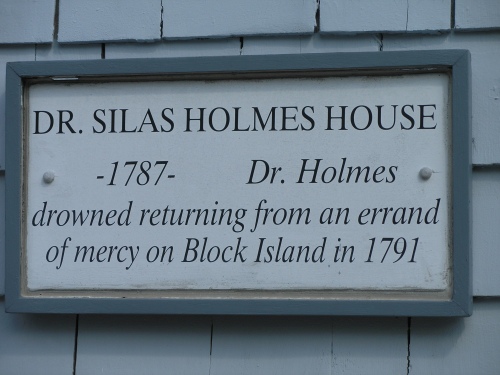
The Stonington Borough house of of Dr. Silas Holmes was built in 1787. Holmes was a physician and, according to Richard Anson Wheeler’s History of the Town of Stonington (1900), “He was summoned to visit a sick man on Block Island, who sent for him in his boat, which took and bore him safely over to the island, and after he had visited his patient and diagnosed his physical condition, he started with the boatman and craft to return to his home in Stonington, but unfortunately a terrible thunder storm arose with a rushing cyclone of wind, which lashed the ocean into fearful waving foam, which capsized their boat and filled it with water, which, in spite of all the efforts of the doctor and the boatman, sunk, and they were both drowned.” Wheeler gives the date of this event as September 12, 1790, but a sign on the house states that “Dr. Holmes drowned returning from an errand of mercy on Block Island in 1791.”

The Captain George Phillips House (1750)

george-phillips-house.jpg

Captain George Phillips was a leading merchant of Middletown and, like his neighbor, Jehosaphat Starr, he answered the Lexington Alarm in 1775. His brick gambrel-roofed house, on Washington Street, was built around 1750. The Greek Revival entryway and the reduction in size of the first floor windows are nineteenth century changes. There is also an obviously later addition to the house’s east elevation.