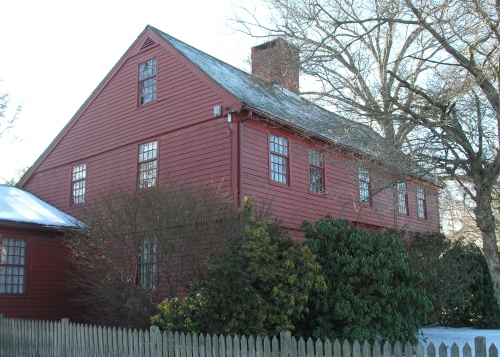
Joseph Arnold House (1765)


joseph-arnold.jpg


Joseph Arnold, not to be confused with the Joseph Arnold who lived in the Thankful Arnold House (although both men were descendants of the original Haddam proprietor, Joseph Arnold), built his home in the center of Haddam around 1765. Joseph’s son, Simon Arnold (1778-1867), occupied the house after his 1804 marriage to Alice Smith (1778-1834). The home was also occupied, from 1838 until his death in 1869, by Samuel Arnold, the son of Joseph and Thankful Arnold. Samuel Arnold served as a US Congressman from 1857 to 1859. The house, which was significantly altered in the nineteenth century but restored in the twentieth century, remained in the Arnold family until 1967.

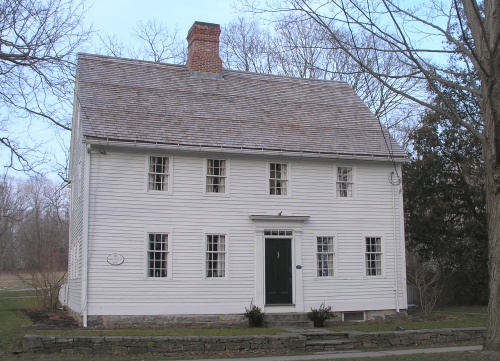
The Moses Andrews Homestead (1760)

Moses Andrews Homestead

The Moses Andrews Homestead, on West Main Street in Meriden, was built around 1760 by Sgt. Moses Andrews‘s father, Samuel Andrews III. Moses was a Tory and during the Revolutionary War, the house was used as the first Episcopal place of worship in Meriden, with Andrews later acting as Lay Reader. The house remained in the family until 1864 and was then used for various purposes over the years, including as a school. In 1933, the house was restored, as a W.P.A project, to become a school and museum. When the school board ceased to use the property, it again became a museum organized by the Andrews Homestead Committee (formed in 1940). The house was again restored in 1954 and is now operated by the Meriden Historical Society as a museum. (more…)

John Pratt, Jr. House (1732)

pratt-house-museum.jpg

The John Pratt House, on West Avenue in Essex, evolved to its present form over many years. John Pratt, Jr. was the grandson of Lt. William Pratt, one of the first settlers of Essex. At the time, the Pratt’s were a family of blacksmiths. In 1701, John Jr. built the gambrel-roofed section, which is now at the rear of the Pratt House. In 1732, he began to construct the front part of the house, which grew over time. The house passed through several generations of the family and became a rental property in the early twentieth century. In 1953, it was given to the Society for the Preservation of New England Antiquities. The house has been owned and operated as a house museum by the Essex Historical Society since 1985.

The Noah Clark Tavern (1791)

noah-clark-homestead.jpg

Noah Clark, Sr. built his house in Haddam on Saybrook Road in 1791. In the seventeenth century, the property had been the location of Haddam’s first meetinghouse. The house served as a tavern in the nineteenth century, run by Noah Clark, Jr. and, after his death in 1834, by his widow, Charity and son, Austin S. Clark. The house was restored in 1997 and is now a private residence. There is also a nineteenth century barn which survives in good condition on the property. (more…)

Thankful Arnold House (1794)

thankful-arnold-house.jpg

The Thankful Arnold House, on Hayden Hill Road in Haddam, was built in three stages between 1794 and 1810. The first section, built in 1794-1795 by Linus Parmalee, was a small house, with a shop on the first floor. The mortgaged house was foreclosed in 1797 and sold to Joseph Arnold, a merchant who had his shop in the basement. In 1800, the second section was built adding two bays to the western end of the house. The third section to be added, in 1810, was an extension to the rear, making the gambrel-roofed house have a saltbox profile. The two-story ell on the west side, which was originally a separate mid-eighteenth century building, was also added at this time. Joseph Arnold died in 1823 and his widow, Thankful Clark Arnold, continued to live in the house, which was known as the Widow Arnold House, until her death in 1849. It was occupied by Arnold descendants until it was purchased in 1963 by one who lived in Texas, Isaac Arnold, who died in 1973, leaving the house to the Haddam Historical Society. By that time, the house had already been restored to its 1810 appearance and opened to the public as a museum in 1965.

Squire Beach House (1762)

squire-beach.jpg

The Squire Beach House, on South Main Street in Cheshire, was built by Samuel Beach, a lawyer and prominent citizen who was a leader in establishing Cheshire as a seperate town from Wallingford. His son, Burrage Beach, was a lawyer and a director of the Farmington Canal. The house, which resembles the Foote House across the street, originally faced South Main. In 1986, the house became a restaurant and was moved and turned so that its gable end now faces the street.

The Hitchcock-Phillips House (1785)

hitchcock-phillips-house.jpg

The Hitchcock-Phillips House, on Church Drive in Cheshire, dates to 1785. The Georgian-style house was built by Rufus Hitchcock, a merchant and leading citizen of Cheshire. A wing was added to the house around 1820 by Hitchcock’s son, William Rufus Hitchcock, who lived there until 1834. The house was next occupied by his sister, Lucretia and her husband, Rev. Peter Clark. Their daughter married A.W. Phillips, a Cheshire Academy instructor and later a Yale professor. They used the house as a summer home until 1907. The three dormer windows were added in 1925. The house was later used by Cheshire Academy as a dorm and was purchased by the town in 1972 to become the museum of the Cheshire Historical Society.