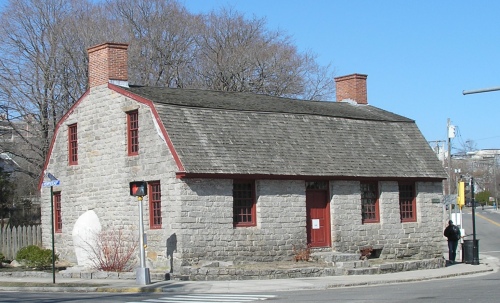
The Nathaniel Hempsted House (1759)

huguenot-house.jpg

The Nathaniel Hempsted House is a stone, gambrel-roofed house on Jay Street in New London. It was built in 1759 by Nathaniel Hempsted, the grandson of the diarist Joshua Hempsted, whose house is located just behind it. Like the William Coit House, the Nathaniel Hempsted House was once on the waterfront, before Bream Cove was filled in. The building was once known as the Old Huguenot House, because it was believed that Huguenots (French Protestants) helped to build it. Actually, it was Acadians (Catholic French Canadian refugees) who were more likely involved in the construction. The house was later sold out of the Hempsted family, but was eventually acquired by Connecticut Landmarks to join the adjacent Joshua Hempsted House as a museum.

The Joshua Hempsted House (1678)

hempstead-house.jpg

Joshua Hempsted is a well-known citizen of colonial New London because he kept a detailed diary for nearly fifty years, from 1711 until his death in 1758. Hempsted was a farmer, surveyor, carpenter, gravestone carver and local official who was born and lived in a house at 11 Hempstead Street, which had been built by his grandfather in 1678. Joshua added the east section of the house in 1728. It is New London’s oldest surviving house and was occupied by the Hempsted family until 1937. With the death of Anna Hempstead Branch, the house was left to the Antiquarian and Landmarks Society, which restored the house in 1956. Today, along with the adjacent house of Joshua Hempsted’s nephew, Nathaniel Hempsted, the Hempsted Houses are a Connecticut Landmarks site open to the public.

William Coit House (1763)

coit-house.jpg

In the eighteenth century, Coit Street (then Cove Street) in New London followed the shoreline of Bream Cove, an arm of New London Harbor. The Cove later shrank in the nineteenth century from silting and filling in to create additional land. When the William Coit House, on the corner of Washington and Coit Streets, was built around 1763, it was therefore on the water, although this is no longer the case. The Coits were a shipbuilding family and William Coit commanded ships during the Revolutionary War. Coit was also captain of a militia company, composed largely of sailors, that marched to the Siege of Boston in 1775.

Samuel Parsons House (1759)

samuel-parsons.jpg

Built around 1759, the Samuel Parsons House, on Main Street in Wallingford, once served as a tavern when stage coaches stopped there. Featuring many traditional colonial elements, the house is transitional in style because it also has features of the Georgian style, including its two chimneys and the way its rooms are arranged inside. Caleb Thompson bought the house in 1803 and built wagons, carriages, and coffins in his shop on the property. His granddaughter, Fannie Ives Schember, leased the house to the Wallingford Historical Society in 1919 and later left it to the Society in her will. Owned by the Society since 1932, today the house is a museum.

Miles Messenger House (1785)

messenger-house.jpg

A beam in the attic of the Messenger House, 667 Cherry Brook Road in Canton, is inscribed with the words: “RAISED 1785 JUNE 20 MONDAY.” In the days when stagecoach used to pass by the house, it was used as an inn. Also, at one time, there was an apple orchard and cider mill on the property. Miles Messenger owned the house in the mid-twentieth century and, after the steeple of the Old North Church in Boston blew down during Hurricane Carol in 1954, Mr. Messenger gave a white oak from his farm to help rebuild it.