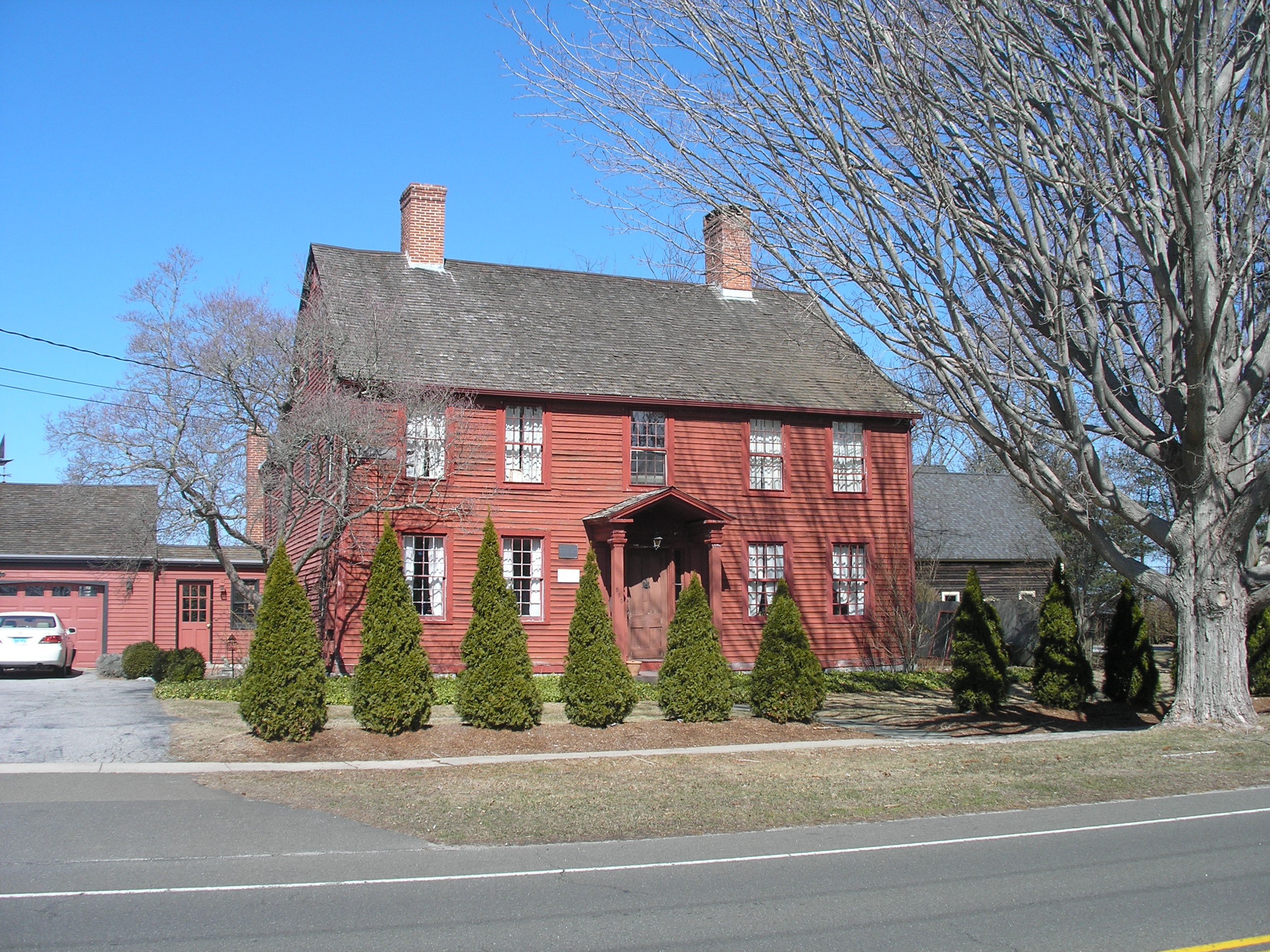
Thomas Danforth House (1783)

danforth-house.jpg

Thomas Danforth II, who was based in Middletown, together with his sons, including Thomas Danforth III of Rocky Hill, were very successful Connecticut metalworkers. Five generations of the Danforth family, between 1730s and 1840s, were involved in metalworking and became famous for producing objects made of pewter and Britannia metal. The Danforth family business employed many peddlers, who sold their wares widely, with a focus on the southern states. Thomas Danforth III has been credited with establishing America’s first chain-store system, with branches in Philadelphia, Atlanta and Savannah. Having spent a number of years traveling between Connecticut and Philadelphia, where his son, Thomas Danforth IV would serve his apprenticeship, Thomas III returned to reside in his home in Rocky Hill. His house, built in 1783, is located at the corner of Glastonbury Avenue and Old Main Street.

Dr. Samuel Eliot House (1737)

Eliot House

According to tradition, the house at 500 Main Street in Old Saybrook was built by Dr. Samuel Eliot around 1737. Records indicate, though, that the house was built by Eliot’s brother, Dr. Augustus Eliot, who was also a physician. The house was likely not completed at the time of Augustus Eliot’s death in 1747. It was sold by his estate to Capt. Samuel Lord in 1749, who then sold it to his son-in-law, Capt. Jabez Stow, Sr. It was Capt. Stow who most likely finished the house. He later served as a lieutenant in the defense of Fort Griswold and was taken prisoner by the British. He died in 1785 and his son, Jabez Stow, Jr., was lost at sea in 1788. The house was then occupied by his daughter, Mary Stow, who had married Capt. David Newell in 1784. According to The History of Middlesex County (1884), “Capt. Newell was engaged in the slave trade, and was killed during a rising of the slaves on board his vessel” at the Island of Boa Vista, in the Cape Verde Islands in 1819. Sea captains’ families continued to live in the house until 1890. It remains a private residence today. (more…)

Rev. Samuel Seabury House (1792)

rev-seabury-house.jpg

On Greene’s Alley in New London is the home of Reverend Samuel Seabury, which was built around 1792. Rev. Seabury was an Episcopal minister and a loyalist during the Revolutionary War, who was selected at a 1783 meeting in the Glebe House in Woodbury to become the first American Episcopal Bishop. Rev. Seabury also lived in an earlier house, built in 1743 (unless it’s the same house?). After his death, in 1796, he was succeeded as rector of St James Church in New London by his son, Rev. Charles Seabury.

Robert Pratt Homestead (1716)

robert-pratt.jpg

The Robert Pratt House, on Route 154 in Centerbrook consists of a main Georgian-style center-chimney house with a smaller wing on the west side. It is possible that the wing was built first, by Robert Pratt, Sr. around 1716. The main part of the house was built around the time Nathan Pratt sold the house to Rev. Stephen Holmes in 1758. Rev. Holmes was the second pastor of the Second Ecclessiastical Society of Saybrook, located in Potapoug, which is now the village of Centerbrook in the town of Essex. As explained in the History of Middlesex County (1884), the Reverend, who died in 1773, “practiced medicine in addition to preaching the gospel.”

The Welles-Chapman Tavern (1776)

welles-chapman-tavern.jpg

The Welles-Chapman Tavern, on Main Street in Glastonbury, was moved from the west to the east side of the street in 1974, when the Glastonbury bank expanded. In the late-eighteenth and nineteenth centuries, the tavern was the stop-over for coaches traveling between Hartford and New London. The tavern (which was also the town’s first post office) was built in 1776 by Joseph Welles. It was purchased by Azel Chapman in 1808. Today, it is owned by the Historical Society of Glastonbury, who have rented it out to a number of tenants, currently the Glastonbury Chamber of Commerce.

The Prince Aspinwall House (1761)

prince-aspinwall-house.jpg

The Prince Aspinwall House is on Centre Street in Mansfield Center. It was either built or enlarged by Aspinwall when he acquired the property in 1761. Aspinwall father, Peter Aspinwall, was from Woodstock and his mother, Rebecca Storrs, was the daughter of one of Mansfield’s original proprietors. From 1794 to 1799, the house was the residence of the Rev. Elijah Gridley, third pastor of Mansfield’s First Congregational Church. In the nineteenth century, a Gothic gabled front entrance was added, but this was later removed and two large dormer windows took its place.