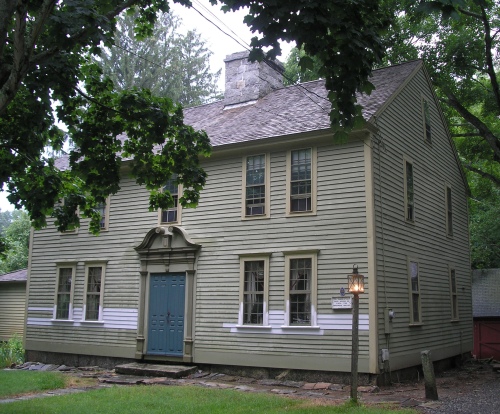
David Nevins House (1746)

Recent (2024) photo of the house taken by the current owner.

The 1746 house of David Nevins, a merchant originally from Nova Scotia who settled in Canterbury, is located across from the Canterbury Green in the Canterbury Center Historic District. The house was built the same year that Nevins married Mary Lathrop, the daughter of Col. Simon Lathrop of Norwich. Nevins died in 1758, in circumstances described in the History of Norwich (1866), by Frances Manwaring Caulkins:

It was while engaged in repairing a bridge over the Quinebaug, between Canterbury and Plainfield, which had been partially destroyed in a severe freshet, that the first David Nevins of Connecticut lost his life. He was standing on one of the cross beams of the bridge, giving directions to the workmen, and had his watch in his hand, which he had just taken out to see the time, when, losing his balance, he fell into the swollen stream, was swept down by the current, and drowned before he could be rescued.

Nevins’ son, also named David, fought in the Revolutionary War. At different times, between 1842 and 1975, the house was used as a Parsonage for the nearby First Congregational Church. In the twentieth century, the house has undergone restoration, including the restoration of the chimney using stones found in the basement of the house.

This is an earlier photo of the house that initially appeared at the top of this post.

Martha A. Parsons House (1782)

martha-a-parsons-museum.jpg

The Martha A. Parsons House, in Enfield, was built in 1792 by John Meacham on property that was initially intended for use by ministers (parsons). In 1800, the house was purchased by John Ingraham, a retired Saybrook sea captain, who placed George Washington Memorial wallpaper in the front hall. In 1906, Juliaette Parsons, the widow of Ingraham’s great-grandson, moved in with her three daughters. One of them, Martha A. Parsons, entered the world of business, eventually becoming secretary of the Landers, Frary & Clark of New Britain in 1912. After a fifty year career, she retired to Enfield to live with her sisters. She died in 1962 and the home was bequeathed to the Enfield Historical Society, which operates it as the Martha A. Parsons Museum.

Huntington Homestead (1700)

Built sometime in the period 1700-1722, the Huntington Homestead in Scotland was the birthplace and childhood home of Samuel Huntington, who went on to become a Signer of the Declaration of Independence, President of the Continental Congress from 1779 to 1781 and Governor of Connecticut. Huntington later lived in a house in Norwich. The Homestead was later owned by the Kimball family, who sold it to the Town of Scotland in 1994. The house was then acquired by The Governor Samuel Huntington Trust to be opened as a museum.

Also, Historic Buildings of Massachusetts now has a new blog theme!!!

Edmund Fanning Birthplace (1761)

fanning-birthplace.jpg

At 44 Main Street in the Borough of Stonington is a house, built in 1761 by the merchant Gilbert Fanning. Fanning was soon forced, due to his economic circumstances, to deed the house to his father-in-law, Dr. Nathan Palmer. Gilbert’s son, Edmund Fanning, was born in the house in 1769 and would go on to become the first American captain to circumnavigate the globe, in 1797-1798, aboard the Betsey, with a crew from Stonington. His elder brother, Nathaniel Fanning, served with John Paul Jones in the Revolutionary War during the 1779 battle of USS Bonhomme Richard and the HMS Serapis.

Ebenezer Avery House (1750)

ebenezer-avery-house.jpg

The Ebenezer Avery House, built around 1750, originally stood at the corner of Latham Street and Thames Street in Groton. On September 6, 1781, American soldiers, including Ebenezer Avery, who had been wounded at the Battle of Groton Heights, were being transported in a cart to become British prisoners. The rolling cart went out-of-control and collided with a tree. The wounded, in agony, were taken to the Ebenezer Avery House. The Averys were a prominent family of early settlers in Groton. Captain James Avery was the first of the family to settle in Groton in the seventeenth century. His son, also named James, occupied a house, built in 1671, known as the Hive of the Averys, which burned down in 1894. The Avery Memorial Association was formed the following year and erected a memorial at the site of the Hive. In 1971, Stanton Avery of California purchased the Ebenezer Avery House and donated it to the Association. The house was moved from its original location to the the grounds of Fort Griswold State Park, where today it is open to the public as a house museum.

Whitehall Mansion (1771)

whitehall-mansion.jpg

The earliest structure built on the original site of Whitehall Mansion, located in the section of Mystic which is in the town of Stonington, was constructed around 1680 by Lt. William Gallup. A tavern and stagecoach stop stood on the site in the 1750s. Whitehall Mansion, named after an ancestor’s home, Whight House, in Essex, England, was built in 1771-1775 by Dr. Dudley Woodbridge (who, in his youth, had made an interesting sketch of buildings in Deerfield, Massachusetts). A secret room in the attic may have housed runaway slaves. Dr, Woodbridge died in 1790 and the house was later owned by the Rodman and Wheeler families. The Mansion‘s last resident, Florence Grace Keach, donated the house to the Stonington Historical Society in 1962 in order to save it from demolition when Interstate-95 was being constructed. The house was moved approximately one hundred yards north and restored. For a time, it was open for tours, but was purchased by the Waterford Hotel Group in 1996 and is now the Whitehall Mansion Inn.

The Nehemiah Hubbard House (1744)

nehemiah-hubbard-house.jpg

Across from the Harriet Cooper Lane House in Middletown is the Nehemiah Hubbard House, a center-chimney Colonial saltbox, built in 1744. Nehemiah Hubbard, Jr., who was born in 1752 and was a later owner of the house, was a fourth-generation descendant of early settlers of Middletown. A prominent merchant, he served as Deputy Quartermaster for Middletown during the Revolutionary War and was the first president of the Middletown Bank. He was also the original land-owner in what would become Hubbard, Ohio. Hubbard used his Middletown house and extensive property, which was away from the center of town, for his farming operations and it remained in his family into the twentieth century. For a time, Thomas McDonough Russell, Sr. lived in the house and in 1916, it was acquired by Colonel Clarence Wadsworth. Restored in 1929, the house remained in the Wadsworth family until 1952. Still a private home, the property has a garden established in 1956.