Elm Tree Inn (1655)

elm-tree-inn.jpg

The earliest section of what later on became the Elm Tree Inn in Farmington was the 1655 house of William Lewis, an original settler of the town. His son built a new and larger structure, around the old house, and the enlarged building became a tavern and inn. By the mid-eighteenth century, it was operated by Phineas Lewis. Washington dined at the tavern, while on his way to Hartford, in 1780 and again, while on his way to Wethersfield, in 1781. The French general Rochambeau may have also stayed there with his officers when he was passing through Connecticut with his army in 1781. The facade of the building was later updated in the Georgian style and the tavern came to be known as the Elm Tree Inn, after the elm trees on the property, planted in the 1760s. The Inn continued to be popular into the twentieth century as it was a stop on the trolley line to Hartford. Mark Twain frequently dined there while he lived in Hartford, as did the cast and crew filming Way Down East with Lillian Gish in 1919. The exterior of the Inn was once surrounded by a long verandah, which has since been removed. The building is now subdivided into condominiums.

Pelatiah Leete House (1710)

pelatiah-leete-iii-house.jpg

Guilford was originally part of the New Haven colony and in 1661, the town granted the land now known as Leete’s Island to William Leete. He became governor of the colony and later became governor of Connecticut. The family built a number of houses on the property, but the oldest one to survive today was built by William Leete’s grandson, Pelatiah Leete (1681-1768) in 1709-1710. In 1781, during the Revolutionary War, the British raided Leete’s Island, burning a house and two barns, but were turned back by local citizens. Pelatiah Leete III‘s brother, Simeon Leete, who shared the house with him, was wounded in the skirmish and died in the house the following day. Built as a saltbox, with an integral lean-to, the house remained in the Leete family until 1929. Harry Glenn purchased the house in 1930 and his wife, Mrs. Dorothy Glenn, first president of the Guilford Keeping Society, operated an antiques shop and tearoom in the house in the 1930s. Later owners built the addition in 1980 and the house was recently restored.

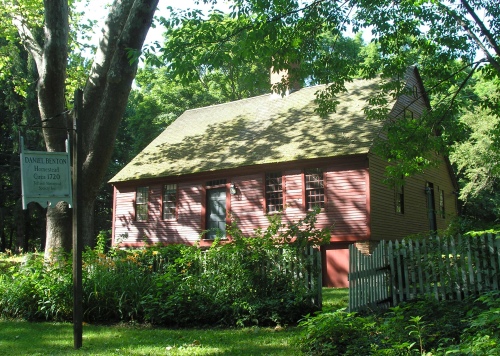
Daniel Benton Homestead (1720)

daniel-benton-homestead.jpg

The Daniel Benton Homestead in Tolland was built in 1720 and was home to members of the Benton family until 1932. In 1777, during the Revolutionary War, twenty-four Hessian officers, who had surrendered after the British defeat at Saratoga, were quartered in the house on their journey to Boston, from where they would be shipped back to Germany. Daniel Benton had three grandsons who fought in the war: two died as a result of imprisonment by the British while the third, Elisha Benton, returned home in late 1776, after his confinement on a prison ship, where he had contracted smallpox. Back home, he was nursed by Jemima Barrows, whom he had courted before the war. He died after a few weeks, and she followed shortly after, having contracted the disease during their time together. They were both buried on the property, but were not buried next to each other, as they had not married. The Daniel Benton Homestead is famous as a haunted house and numerous articles with ghost stories about the house have been written on many sites. The house was purchased in 1932 by Florrie Bishop Bowering, a WTIC radio personality, who lived there until she died in 1968. The next owners, Charles B. Goodstein and William A Shocket, donated the house the following year to the Tolland Historical Society to open as a museum.

Riley-Gridley House (1780)

Riley-Gridley House

The Riley-Gridley House was probably built around 1780 by Julius Riley, in Cromwell, at a time when it was a part of Middletown known as “Upper Houses.” Riley sold his house in 1784 to Isaac Gridley, with the stipulation that his two unmarried sisters could live in the house until they married; they never did and remained in the house, both living to be over 100 years old. Isaac Gridley was a graduate of the Yale Class of 1773 and had been a roommate there of Nathan Hale. He bought the house in Cromwell the same year he married Elizabeth, the daughter of Capt. John Smith. From 1855 to 1880, the house was owned by Elizabeth Crocker, the widow of Zebulon Crocker, the former minister at the First Congregational Church of Cromwell. (more…)