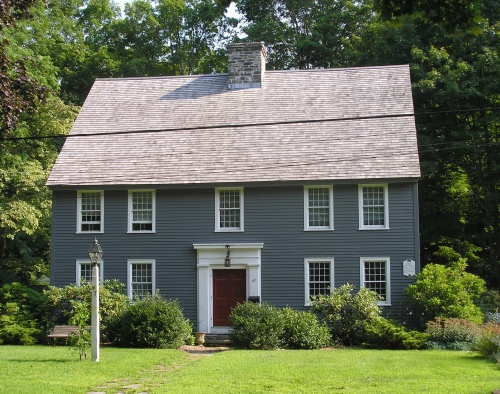
Marlborough Tavern (1740)

marlborough-tavern.jpg

Built in 1740 at the intersection of two main roads in what would later become the town of Marlborough, the Marlborough Tavern has served, over the years, as a tavern, hotel and, in the 1790s, a post office. It is currently a restaurant. According to the Report of the Celebration of the Centennial of the Incorporation of the Town of Marlborough, August 23d and 25th 1903 (1904), by Mary Hall:

Marlborough was lifted from its isolated condition by the building of the Hartford and New London turnpike in 1800, the incorporation of the Hebron and Middle Haddam turnpike company in 1802, and of the Chatham and Marlborough company in 1809. The completion of these roads was of great advantage to the town. The barns of the Marlborough inn or tavern, then kept by Elisha Buell. furnished a place for change of horses and refreshment for travelers. Guests of national reputation were frequently entertained here. Among those known to have been entertained were Presidents James Monroe and Andrew Jackson.

The Marlborough Tavern was built by the Buell family and in the late eighteenth to early nineteenth centuries was operated by Col. Elisha Buell, who also established a “gun manufactory and repair shop” and was “a fine workman in iron and steel,” creating the Buell Musket. His son, General Enos Buell, was a captain in the War of 1812 and succeeded his father as postmaster. Sheriffs transporting prisoners to Old Newgate Prison would stop at the Tavern, where their was a holding cell on the third floor. The Tavern also became the summer home of Mary Hall, compiler of the book quoted from above. Hall became Connecticut’s first female lawyer after the the Connecticut Supreme Court upheld her right to be an attorney in 1882. Hall practiced law for more than four decades and also founded the Good Will Club of Hartford, a charity for boys.

Second Dr. John Redfield House (1780)

the-second-dr-john-redfield-house.JPG

Dr. John Redfield of Guilford, who was living in an earlier home built in 1768, constructed a new mansion house on the Green in 1780. The property where the new house was built had previously belonged to David Naughty, a merchant. After Naughty’s death in 1739, his wife Ruth Naughty was co-executor of his will, along with nephew David Naughty II. Ruth Naughty successfully managed her husband’s affairs, paying his debts in Boston. When she died in 1773, she named Dr. Redfield as executor of her will, but he was soon caught up in a lawsuit with David II. Dr. Redfield won the case and, as owner of the entire property, tore down the Naughty House in order to build his own. The outraged Naughty later stipulated in his will that he be buried across the Green from Redfield’s house with his head sticking out above ground to stare at his enemy’s home. These wishes were never carried out. Since 1945, the Redfield House has been owned by the Guilford Savings Bank and serves as the bank’s main office.

The Hull-Hitchcock House (1764)

amos-hull.JPG

The Dr. Amos Hull House, built in 1764, is at 744 South Main Street in Cheshire. Dr. Hull used the house as a home and office. He served in the Revolutionary War, dying in camp in 1776. His widow, Martha Hitchcock, then married Dr. Gould Norton, who occupied the house, practicing medicine and running a tavern. The house was then owned by Pliny Hitchcock, who died in 1864 and was a stonemason and one of the leading farmers of Cheshire. In the 1930s, the house was extended by one bay (adding one window) to the right. By 2002, the Hull-Hitchcock House and the nearby John Hull House were in deteriorating condition and in danger of being torn down, until developers who acquired the properties agreed to restore both houses. Readers of Historic Buildings of Connecticut might also be interested in reading today’s post at Historic Buildings of Massachusetts, which features the Joseph Moore House, located in what is known as the Southwick Jog, the section of Massachusetts which extends into Connecticut’s northern border.

The First Dr. John Redfield House (1768)

dr-john-redfield.jpg

Dr. John Redfield, who had studied medicine with Dr. Benjamin Gale of Clinton, settled in Guilford and in 1768 built the first of two houses he would occupy in the town. His first house was on Park Street and, in later years, a Victorian porch was attached in the front. In 1937, the house was disassembled to make way for a new town hall parking lot. In 1942, the house (without the Victorian porch) was rebuilt on Broad Street for Judge George C. Conway. The house has a particularly steep roof which provides enough space for two attic windows in the gable. Historic Buildings of Connecticut now has a page on Facebook. If you are a Facebook user, you can become a fan!!

The Joseph Parmelee House (1748)

joseph-parmelee-house.jpg

The Joseph Parmelee House is on Water Street in Guilford and was built in 1748. Joseph Parmelee (1721-1804) was married three times, to Obedience Spencer, Abigail Cruttenden, and Mary Deming. At one time, the house had a lean-to, but this was later removed and other additions were then attached. The front door is surrounded by an impressive Greek Revival enframement, which was added later and has double pilasters on either side.

Stephen T. Mather Homestead (1778)

mather-homestead.jpg

The Stephen T. Mather Homestead, in Darien, is named for Stephen Tyng Mather, who laid the foundation of the National Park Service. The Mather Homestead was built in 1778 by Deacon Joseph Mather, son of Reverend Moses Mather, who was minister of the Middlesex Parish Church. During the Revolutionary War, there was much raiding by Tories along the coast of Long Island Sound, but the Mathers felt that their property was far enough inland to be safe. They encouraged friends and relatives to hide their money and valuables at the house until the war ended, but on the night of March 19, 1781, a gang of Tories raided their home and forced the Mathers to reveal the hidden items. During the War, Joseph Mather was an Ensign in the Connecticut Militia, fighting at Montreal in the 1775 invasion of Canada, and he was also a sergeant in the Coast Guard. Mathers have continued to own the Homestead since it was built. In the later nineteenth century, it had passed to Joseph Wakeman Mather, who moved to San Francisco to develop business interests there. His son, Stephen, was born in California in 1867. Stephen Mather went on to become a millionaire as president and owner of the Thorkildsen-Mather Borax Company. Inspired by his meeting with John Muir in 1912, Mather complained to the federal authorities about the government’s neglect of the nation’s National Parks. Soon working in the Interior Department, he established and became the first director of the National Park Service. He continued to own his family’s Homestead in Darien, using it as a summer residence. After his death, in 1930, the house was owned by his daughter, Bertha Mather McPherson, a founding member and the first president of the Darien Historical Society.

Update: In 2017, the Mather House became a museum open to the public.