David Ogden House (1750)

David Ogden and his new wife, Jane Sturges Ogden, moved into a recently completed house in Fairfield in 1750. The house remained in the Ogden family for the next 125 years, surviving the burning of Fairfield by the British in 1779. The house later fell into bad repair, but in the 1930’s, it was restored by the architectural historian J. Frederick Kelly. Today, this saltbox colonial house is museum, operated by the Fairfield Museum and History Center and furnished according to information in David Ogden’s will and estate inventory. (There is more information in this pdf file)

The Daniel Judd House (1730)

The Daniel Judd House in Farmington (not to be confused with the 1875 Daniel Judd House in Cheshire) is a colonial saltbox home built around 1725-1730. The house was built on land that Daniel Judd inherited from his parents, William and Mary Steele Judd, early settlers of Farmington. Judd sold his house to his oldest surviving son, James, in 1741 and it was willed to James Judd, Jr. in 1779, although the younger James lost his money and the property was foreclosed on in 1805. It then passed through various owners until it was acquired by James O’Rourke in 1874. In 1890, O’Rourke rented the house to Theodate Pope, daughter of the wealthy industrialist Alfred Atmore Pope. She soon purchased the house in 1892. Calling it the “O’Rourkery” after its previous owner, Pope hired the architectural firm Hapgood and Hapgood to restore the house. Some years later, she added a side entrance porch to the house and would continue to make other alterations to the building over the years.

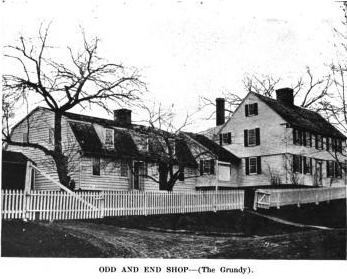
In 1896, she acquired the property next to her home, which included an earlier, seventeenth-century dwelling, possibly built for William Judd. She had this building moved and attached to the O’Rourkery as an ell. Calling it the “Gundy,” Pope opened the ell in 1902 as an “Odds and Ends Shop” for students at Miss Porter’s School. Pope would later persuade her parents to settle in Farmington, using her experiences in restoring the O’Rourkery in designing for them the famous Hill-Stead estate. She would go on to design a number of other buildings. Theodate Pope later resided at Hillstead with her husband, John Wallace Riddle, but continued to own the O’Rourkery, using it as a retreat. After her death, the estate, including the O’Rourkery, became the property of the Hill-Stead Museum. The Gundy shop continued in operation under various people until 1969, but in 1975 the Museum sold the house. It is now a private residence. Behind the Gundy today is a notable (private) Colonial Revival garden.

The Maj. Peter Curtis House (1786)

Maj. Peter Curtis was a blacksmith in Farmington who served as an officer in the army at every battle in which George Washington commanded during the Revolutionary War. In 1769 he had purchased the property formerly owned by Thomas Norton, replacing the earlier house, at the corner of Farmington Avenue and High Street, with his new house, built by Judah Woodruff in 1786. Curtis later served as the first keeper, or warden, of Newgate Prison in East Granby, from 1790 to 1796. His family occupied the house until 1822, when it was sold to William Whitman, who opened it as a tavern, with a ballroom on the second floor. After his death in 1876, the tavern was run by his son Charles L. Whitman, of whom it was said, as related in Farmington, Connecticut, the Village of Beautiful Homes (1906),

He and his father for many years kept a tavern in Farmington. in the days when there was much teaming through this town. The place was famous in all the region, partly on account of Mrs. Whitman’s excellent pies and cake. When one’s ancestors have been among those who serve the public with care and courtesy, it seems to become second nature in the descendants to be very polite. This might explain Mr. Whitman’s genial manners, but I am inclined to believe it was more a special goodness of heart. He was also for many years one of the directors of the bank and an appraiser.

In the 1920s, rooms in the house were rented to two women for use as a tea room and antiques business. In 1938, the house was acquired by Dr. Walls Bunnell, who moved it to its present location at 4 High Street. Where the Whitman Tavern had originally stood, Dr. Bunnell created the shopping complex known as Brick Walk Lane, composed of various historic Farmington buildings he preserved by having them moved to the site.

285 Bolton Center Road, Bolton (1720)

The house at 285 Bolton Center Road in Bolton originally stood at the corner of High and Wadsworth Streets in East Hartford. It was moved to Bolton in the early 1990s by historic home restorers Len and Betty Matyia. The house, which may have been built as early as the late seventeenth century through around 1730, has been linked to the original Hartford proprietor William Hill, who traveled with Rev. Thomas Hooker to found the new settlement in 1636. Hill was captain of Hartford’s first trainband on the east side of the Connecticut River. The discovery of a connection with Hill in 1992 led to some controversy concerning the removal of the historic house from East Hartford. Restored to a post-Medieval appearance, the house is now situated in a rural colonial setting with an adjacent post and beam barn.

Jonathan Dickerman II House (1792)

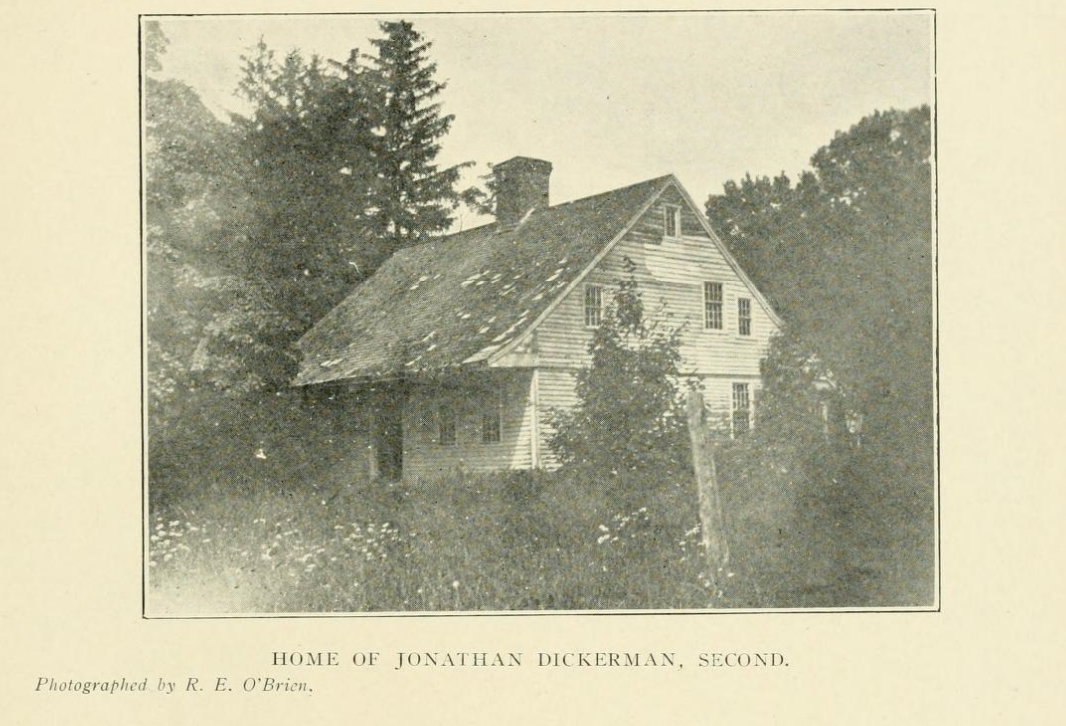
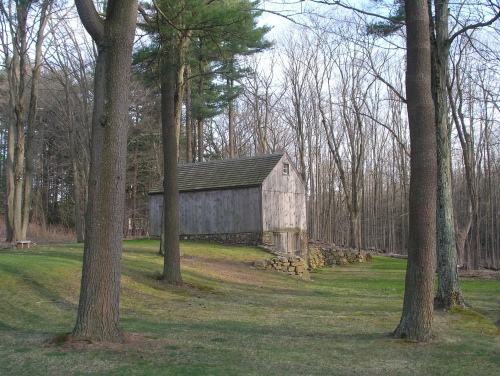
In 1792, Jonathan Dickerman II built a farmhouse in Hamden, south of the Sleeping Giant, also known as Mount Carmel. Originally located on the north side of Mount Carmel Avenue, the house was acquired by the state in 1924, serving for a time as a ranger station when the Sleeping Giant State Park was being created. In 1961, when the Avenue was being straightened, the state gave the Dickerman House to the town and, the following year, it was moved across the street to its current location by the Hamden Historical Society. A historic cider mill barn was moved to the property in 1992 and an outhouse in 2002.