Deacon John Moore House (1664)

John Moore, ordained a deacon in 1651, was one of the original settlers of Windsor, arriving in 1635 with the Dorchester group, led by the Reverends Maverick and Warham. Moore was a woodworker associated with the “Foliated Vine Group” of seventeenth-century chests. Moore’s house, built around 1664, originally stood on the east side of Broad Street Green. In the late eighteenth century, the large house of William Loomis was built on the west side of the Green and the old Deacon Moore House was moved and attached to the rear of the new house as a kitchen ell. By the end of the nineteenth century, the combined house was owned by Horace Clark, who detached the ell around 1897 and moved it to 37 Elm Street. In its new location, the Moore House originally had its gable end to the street, but was later moved to face the street. The house originally had the large center chimney typical of First Period Colonial houses.

The Williams-Salter House (1711)

The oldest surviving house in Mansfield Center is the Williams-Salter House, built around 1711. It was first the home of Rev. Eleazer Williams, Mansfield’s first settled minister and the son of Rev. John Williams, who was famously taken to Canada, along with five of his children, after the Raid on Deerfield in 1704 (Eleazer was away at school at the time). Eleazer Williams resided in the house until his death in 1742. He was succeeded as minister by Rev. Richard Salter, who married Williams’ daughter Mary in 1744 and purchased the privately-owned parsonage in 1745. Rev. Salter and his brother, John Salter, who also settled in Mansfield, were from a prominent Boston family. Richard Salter, one of the most respected ministers in Connecticut, served in Mansfield until his death, in 1787. The property also has a notable English-style barn.

The James Curtiss House (1737)

The James Curtiss House is a saltbox home on Maiden Lane in Durham. Curtiss purchased the land on which his house stands in 1722 and the house was built sometime between 1737 and 1761, when deeded half of his property to his son, Nathan Curtiss. Nathan was killed in the Revolutionary War in 1776 and his son, James, who inherited the property, was killed in an explosion at the gunpowder manufacturing mill he operated. His widow lived in the house until 1819, but his children migrated to New York and Michigan. In the 1820s, William H. Walkley bought out the shares of the various Curtiss inheritors.

Hillbrow House (1718)

Hillbrow is a colonial house, built around 1718, at 74 Main Street in Newtown. Built, according to the original deed, at the “Head of Main Street,” the house gained its name from its position on the brow of the hill above the street. A granite marker in the front steps is engraved with the name “Hillbrow.” The land where the house stands was acquired by John Blackman in 1715. Later in the eighteenth century, it was owned by Ziba Blakeslee, a clockmaker, silversmith and bellfounder. As described in Newtown’s History and Historian: Ezra Levan Johnson (1917):

Ziba Blakeslee is said to have been a most skilled workman and manufactured all kinds of jewelry. His advertisement in the Farmers Journal, Dec. 22, 1792, shows that he carried on at the head of the Street in Newtown, the goldsmith’s business in all its branches; cast bells for Churches, made and repaired surveyor’s instruments, church clocks and clocks of all kinds.

Also, check out my most recent Massachusetts entry on the Library in Granville, designed by George Keller.

The Cook-Fowler House (1772)

Located across from the Public Library on Main Street in Durham, the Cook-Fowler House is a gambrel-roofed, central-chimney, “Cape Cod“-style cottage. It was built in 1772 by Jesse Cook, a carpenter, a year after his marriage to his third wife, Ann Griswold. Built by himself, the house was later given to Cook’s brother Thomas in 1790. It was later owned by the Lyman family and in 1860 became the home of William Chauncey Fowler, a professor, son-in-law of Noah Webster and author of a number of books, including Memorials of the Chaunceys (1858), The Sectional Controversy (1863) and History of Durham, Connecticut, from the first grant of land in 1662 to 1866 (1866). Two dormer windows were added to the house around 1850.

Josiah Bronson House (1738)

The oldest surviving house in Middlebury was built by Josiah Bronson on Breakneck Hill Road in 1738. The house also served as a tavern and hosted a number of French officers during the Revolutionary War: first in 1781 when Rochambeau’s French army encamped in Middlebury from June 27 to July 1, on its way to the Siege of Yorktown, and again from October 26-28, 1782, during their return journey. One of the officers to stay in the tavern was the Baron de Viomenil, who was second in command to General Rochambeau during the Yorktown Campaign. At these times, Rochambeau himself most likely stayed with Captain Isaac Bronson, Josiah’s father, further down the hill. The Josiah Bronson House was acquired in 1940 by Lawrence M. and Esther Duryee, who restored it.

Sun Tavern (1780)

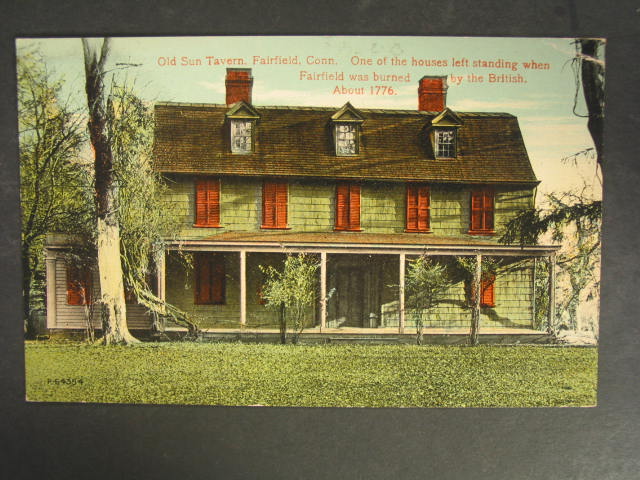
Sun Tavern, on the Fairfield Green, was built about 1780, replacing an earlier Sun Tavern, burnt during the British raid of 1779. The Tavern was operated by Samuel Penfield, who acquired the property in 1761. George Washington stayed at the Tavern the night of October 16, 1789, during a presidential tour of New England. The building, which had an early ballroom on the third floor, remained a tavern until Penfield’s death in 1811, after which it passed through several owners as a private home. It was purchased by Robert Manuel Smith in 1885 and remained in the Smith family until 1977. The following year, it was acquired by the Town of Fairfield and was used as the Town Historian’s residence into the early 1990s. Still owned by the town, Sun Tavern has been recently restored and is now managed as a historic site by the Fairfield Museum and History Center.