Turel Whittemore Tavern (1778)

Located across from where Pearl Street splits from South Main Street, on a high bluff above the Naugatuck River, is a structure that was perhaps built as early as 1740. It was acquired around 1778 by E. Turel Whittemore and served as a tavern. At that point, the building was only one story high. The second story was added in 1867 by Martin Castle, who dismantled the building’s old chimney and used the stones to constructed the terraced wall in front of the property. On the northwest corner of the old tavern was a barroom, where in 1780 a group of Torries planned the robbery of the home of the Patriot, Capt. Ebenezer Dayton, which was located in Bethany. This infamous incident led to the dramatic kidnapping, in nearby Oxford, of the Patriot boy, Chauncey Judd, a 16-year-old member of the Oxford militia, who ran into the fleeing robbers. They were later captured and sent to Newgate Prison and Judd was freed. The Whittemore Tavern has housed various businesses over the years.

The Camp-Meigs House (1760)

The Camp-Meigs House, at 40 Main Street in Durham, is thought to have been built around 1760. It was probably built by Samuel Camp, who had gotten married in 1758 and then inherited the property from his father, John Camp, in 1767. It was later passed to Samuel’s son, Ozias, and then to Ozias’s daughter Mary and her husband, Phineas Meigs. The house was later owned by the Seward family from 1890-1964 and in 1980 was extensively rebuilt to become Camp’s Tavern restaurant. Today, the house is used as offices.

Joseph Jones House (1776)


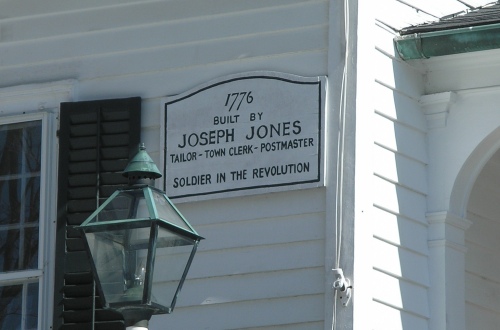
According to a sign on the Joseph Jones House on Norfolk Green, it was built in 1776 (although according to another source, the house was built in 1780). Again, according to the sign, Jones was a tailor, town clerk and postmaster in Norfolk and served in the Revolutionary War. He married Abigail Seward in 1772. As related in the History of Norfolk, Litchfield County Connecticut (1900), compiled by Theron Wilmot Crissey:

The post office was kept in this house for a number of years. Mr. Jones was the post-master in 1816, at the time of the ordination of Mr. Emerson, and died in 1832 at the age of 82. His record as a soldier in the revolutionary army is mentioned in that connection. Before he went into the army Mr. Jones had the frame of his two story house up to the rafters. Upon his return from the war he felt too poor to build a two story house. so he cut off the posts and made it one story, as it is today. Some of the later occupants, who were tall people used often to wish, as they bumped their heads in those low chambers, that Mr. Jones had not cut off those posts so short. A child was born to Mrs. Jones soon after he entered the army, which he never saw till it was three years old, as he did not return home in all that time.

Nathan Bulkley House (1750)

Like the Justin Hobart House and the Isaac Tucker House, the Nathan Bulkley House, built in 1750, survived the burning of Fairfield by the British in 1779. According to The Old Burying Ground of Fairfield, Conn. (1882), by Kate E. Perry, Nathan Bulkley “was deacon in the Congregational Church; a prominent man in town affairs, and Town Clerk for 82 consecutive years. He married Sarah, daughter of Joseph Perry, I. At the burning of Fairfield Nathan Bulkley owned the ‘Colonial home’ which descending to the second wife of the late Dr. J. T. Denison, is yet standing and In good repair.”

David Williams House (1766)

Built by David Williams, a ship builder, in 1766-1767 (and later expanded), the house at 27 West Avenue in Essex was acquired by Abel Pratt in 1798. According to the 1884 History of Middlesex County,

The manufacture of combs in this country was first begun by Phineas Pratt and his son Abel, about the close of the last century. They were the first inventors of machinery for cutting the teeth upon combs, by which they could be produced so as to compete with English manufacturers. The shop in which they worked stood a few yards west of the site of Pratt’s blacksmith shop, and the first machinery was driven by wind power. Abel Pratt carried on the business during the first years of this century [the nineteenth].

In the later nineteenth century, it was owned by members of the Pratt family connected to the nearby Pratt Smithy, established in 1678 and handed down through ten generations.