Azel Backus House (1750)

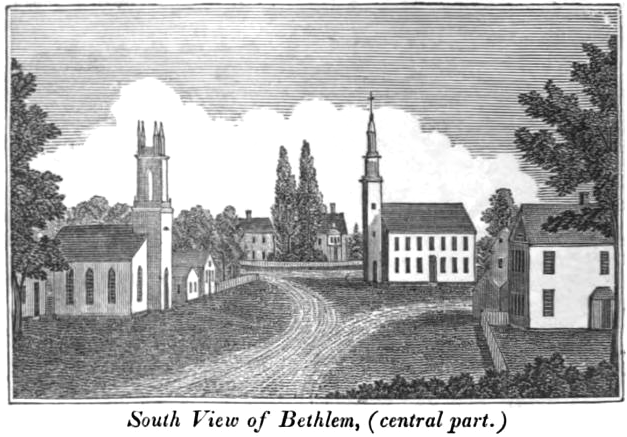
In the view of Bethlem (Bethlehem) by John Warner Barber in his Connecticut Historical Collections (1836), the homes of the town’s first two Congregational ministers can be seen in the distance, behind a fence to left of the Congregational church. To the right is what is now called the Bellamy-Ferriday House, home to Rev. Joseph Bellamy. To the left of Rev. Bellamy’s house is that of his successor, Rev. Azel Backus, who served as minister from 1791 until 1812, when he became the first president of Hamilton College in New York. His former home in Bethlehem, built around 1750, was later moved from where it stood in Barber’s image to the nearby corner of East Street and Main Street South, just off Bethlehem Green. In the early twentieth century, it was home to Dr. William Doolittle and was called Doolicor (Doolittle’s Corner) Place (named as such in a pdf file of a 1934 listing of members of the American Public Health Association).

Loomis Homestead (1640)

The oldest house in Windsor is the Loomis Homestead, located on the campus of Loomis Chaffee school. The oldest part of the house is now the south ell, built by Joseph Loomis in 1640. His son, Deacon John Loomis built the main section in 1688, the year he died, possibly for his son Timothy. In the 1870s, planning began for what would become Loomis Chaffee, established by five Loomis siblings, children of Colonel James Loomis and Abigail Sherwood Chaffee, who had all lost their own children. The school’s first buildings, completed in 1913-1916, were designed to match the axis of the Loomis Homestead, several degrees off of true north. The old house itself remained in the Loomis family until Miss Jennie Loomis deeded it to the Loomis Institute in 1901. She continued to reside in the house until her death, in 1944. Then it became a residence for a member of the Loomis Chaffee School faculty and continues as a museum and memorial to the Loomis family.

Bellamy-Ferriday House (1754)

Joseph Bellamy was a prominent Congregationalist minister, theologian and leader during the Great Awakening. He was pastor of the First Church of Bethlehem from 1760 until his death in 1790. Rev. Bellamy was the author of twenty-two books, the best known being True Religion Delineated (1750). In 1760, Bellamy moved into a Bethlehem farmhouse built in 1754. In 1767, he expanded the house and his son David, a farmer and legislator, added Federal-style embellishments (the Palladian pavilion on the south front) in the 1790s. After the Bellamys, some additional changes were made as the house had various other owners. The property continued as a working farm. In 1912, it was acquired as a summer residence by Henry McKeen and Eliza Ferriday of New York. After Henry’s death, his widow and daughter, Caroline Ferriday, continued to make improvements to the house and established a formal garden. After her mother’s death, Caroline Ferriday sought to restore the house, removing later Victorian-era additions. Miss Ferriday was an actress, conservationist and philanthropist. She left her house and furnishings to the Antiquarian and Landmarks Society (now Connecticut Landmarks) upon her death in 1990. Much of her land is now owned by the Bethlehem Land Trust, which she had helped to establish. (more…)

Barnes-Waldo House (1789)

Jonathan Barnes, a lawyer, was born in Southington in 1763, graduated from Yale in 1784, studied at the Litchfield Law School, and was admitted to the bar in 1789. He soon settled in Tolland, which had become a county seat in 1785. He married Rachael Steele in 1789. Barnes, who served as a town selectman in Tolland from 1798 to 1802 and in the Connecticut Legislature for twenty-eight terms, died in 1829. His oldest son, also named Jonathan Barnes, later became a prominent lawyer in Middletown. The Barnes House, at 34 Tolland Green, was next owned by Obediah Waldo, also a lawyer, who served as selectman, postmaster, town clerk, and member of the state House of Representatives. The house’s side ell was once used as an office.