Dr. Daniel Hooker House (1725)

Daniel Hooker – Timothy Griswold House

Built on Main Street in Wethersfield around 1725 for Dr. Daniel Hooker, a grandson of Thomas Hooker. It is the oldest surviving two chimney house in Wethersfield and is transitional because it lacks the Georgian center hallway typical of later two chimney houses. The house was enlarged in 1825 by Timothy Griswold. (Thanks to Anne Kuckro for information on this house).

(more…)

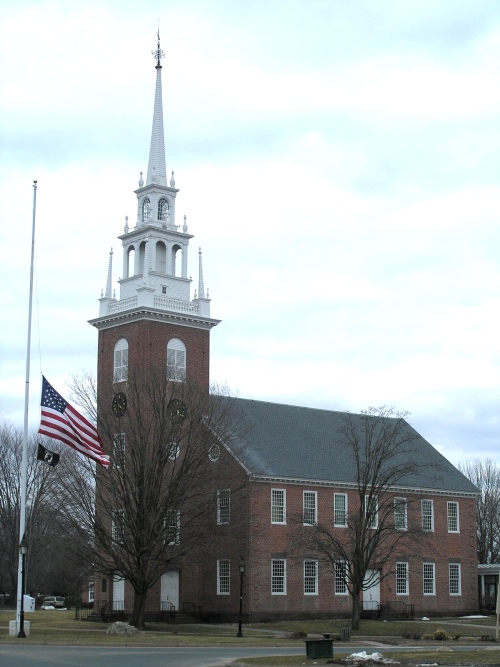
First Church of Christ, Wethersfield (1761)

first-church-wethersfield.jpg

Built in Wethersfield in 1761-1764, the First Church of Christ was the town’s third Meeting House. Designed in the Georgian style, it is a rare survival of a brick colonial meeting house. The steeple was most likely modeled on that of an Episcopal church, Trinity Church in Newport, R.I., which was in turn modeled on Christ Church in Boston. George Washington and the Comte de Rochambeau attended services here on May 20, 1781, during the period they were holding their important meetings in the nearby Webb House. In 1774, John Adams, who was visiting Silas Deane, wrote in his diary:

“We went up the steeple of Wethersfield meeting-house, from whence is the most grand and beautiful prospect in the world, at least that I ever saw.”

Cove Warehouse (1690)

Cove Warehouse in Wethersfield

Built around 1690 at Wethersfield, where there was a bend in the Connecticut River in the seventeenth century. At that time, this and other warehouses stored goods like lumber and foodstuffs (including Wethersfield’s famous red onions) before transport as part of the town’s flourishing trade with the West Indies. In exchange, Wethersfield’s merchants and ship captains would import sugar, molasses and rum from the Caribbean. Around 1700, a hurricane changed the course of the river, turning what was once a bend in the river into the present cove. The accompanying flood swept away the other six warehouses, leaving only this one. It was restored in 1934 and is today a museum run by the Wethersfield Historical Society which houses an exhibit on Wethersfield’s maritime history of the seventeenth and eighteenth centuries.

covewarehouse.jpg

Tapping Reeve House (1773) and Litchfield Law School (1782)

Tapping Reeve, a lawyer, and his wife, Sally Burr Reeve, settled in Litchfield in 1773. The next year, Reeve began teaching law to his wife’s brother, Aaron Burr, who was living with the couple. Starting with this single student, Reeve developed a curriculum which would be taught to almost 1,000 students over the following decades, as he expanded from his home to a one-room school house he had built next-door, in 1784. Because this was a time before the creation of formal law schools at the major Universities, this Litchfield Law School is regarded as being the oldest law school in the country. The school’s students included such notables as John C. Calhoun and Oliver Wolcott, Jr. In 1798, Reeve was joined by James Gould and the two operated the school together until 1820. Gould would continue to run it until 1833. The law school building was later moved from the site, but was eventually returned and restored in 1976. Today both the house and school are open as a museum run by the Litchfield Historical Society. (more…)

First Church, Farmington (1771)

first-church-farmington.JPG

Built in 1771 in Farmington as the third Meeting House of a congregation which originated in 1652. The First Church of Christ, Congregational was built by Capt. Judah Woodruff and features a steeple which has been described as perhaps the most beautiful in New England. The building‘s Greek Revival porch was added in the nineteenth century. This church shows the evolution from a square colonial Meeting House to a Georgian church with a tower at one end. In the nineteenth century, the freed Amistad survivors were supported by members of the congregation and attended services here when they came to Farmington in 1841, awaiting the funds to return to Africa.

Sarah Whitman Hooker House (1720)

sarah-whitman-hooker-house.JPG

Built in the early eighteenth century on New Britain Avenue in West Hartford for Timothy Seymour. The house was gradually expanded throughout the century from an original one room “with chamber above” into a saltbox. In the first decade of the nineteenth century, a later owner removed the saltbox addition and remodeled in the Federal style, enlarging the house to its current size. The home is named for Sarah Whitman Hooker. Her husband, Thomas Hart Hooker, a descendant of Thomas Hooker, bought the house in 1773. When he died after going to fight at Boston in 1775, she lodged two Tory prisoners of war in the home during the winter of 1775-1776. The house has been restored and is currently a open as a museum.