
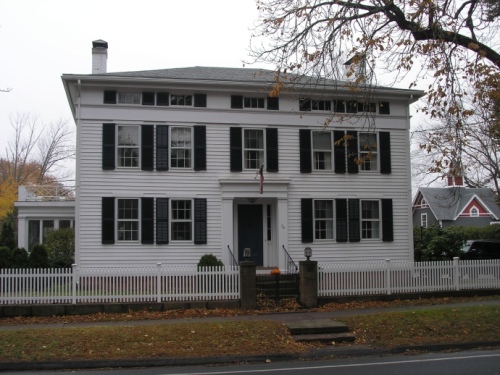
Kimberly Mansion, on Main Street in Glastonbury, was built sometime in the early eighteenth century by Eleazer Kimberly, a Secretary of the Connecticut Colony. It was purchased in 1790 by Zephaniah Smith, a former Sandemanian minister, who had become a lawyer. He added an addition to the house, with a separate entrance, to serve as his law office. He and his wife, Hannah Hickok , an amateur mathematician and poet, would raise five talented daughters in the house: Hancy, an inventor; Laurilla, an artist; Cyrinthia, a poet; and Julia and Abby, who would become famous political activists in the nineteenth century. Julia was also a scholar who, in 1876, published the first translation of the Bible into English by a woman.
Although they were involved, together with their mother, in Abolitionism in the years before the Civil War, Julia and Abby Smith became known throughout the country in the early 1870s for their stand against the unfair assessment of their land by the Glastonbury tax collector. By this time, the two unmarried elderly sisters were the only survivors of their family and owned the most valuable property in town, but as women they could not vote and so were taxed without representation. They therefore refused to pay taxes until they were granted a say in the use of their money. The tax man then seized and auctioned off their cows to pay the taxes. This incident, and other confrontations that followed, were extensively covered in contemporary newspapers and the sisters became prominent in Women’s Suffrage circles. After two years of legal wrangling, they would eventually win a court judgment in 1876, but not the vote. After Abby’s death, Julia finally married and moved to New Hampshire, at the age of 87!


You must be logged in to post a comment.