Ruth Callander House (1715)

ruth-callander-house.jpg

The Ruth Callander House, also known as the White-Overton-Callander House, is on Main Street in Portland and was built around 1715 by Nathaniel White. The house was later expanded with a rear section to cover the well. Ruth Callander was a resident of the house in the twentieth century. She was a charter member of the Portland Historical Society and upon her death she bequeathed her house to become a museum of the town’s history. It opened to the public in June 2003 as the Ruth Callander House Museum of Portland History.

Moor’s Charity School (1755)

moors-charity-school.jpg

One hundred years ago, a man of worth,
With a big heart–Old Windham gave him birth–
Started in Lebanon–Columbia now the name–
A little school the forest sons to tame:


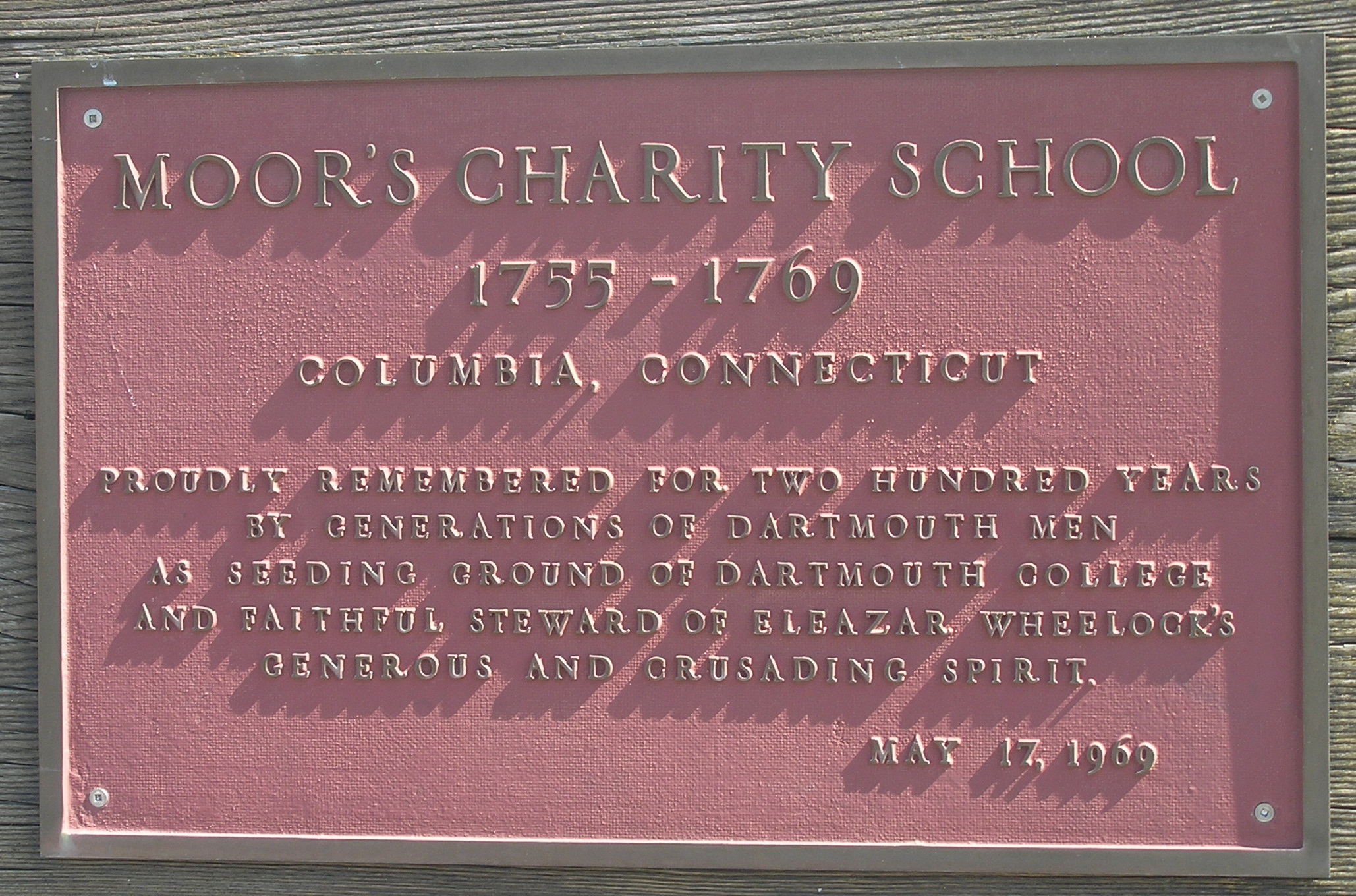
So run four lines from a poem by Dr. O.B. Lyman in honor of Rev. Eleazar Wheelock, the founder of Dartmouth College in Hanover, New Hampshire. The origins of that college began in 1754 in a part of Lebanon which is now the town of Columbia. Rev. Wheelock, an important minister of the Great Awakening, founded a school called Moor’s Charity School, which was dedicated to providing a Christian education for Native American Indians who might serve as missionaries to the Indian tribes. A 1755 school building, used by Wheelock, survives in the town of Lebanon today, although it was later altered in the Greek Revival style. Eventually, as Wheelock was having difficulties recruiting Indian students due to the school’s distance from tribal lands and as he also wished to expand his school to include a college for whites, he decided to move the institution. In 1770, the move to New Hampshire was completed, a year after receiving a royal charter, the last to found a college in Colonial America before the Revolution. For this reason, the Moor’s Charity School in Lebanon was described, in a 1969 plaque placed on the side of the building, as “Proudly remembered for two hundred years by generations of Dartmouth men as seeding ground of Dartmouth College and faithful steward of Eleazar Wheelock’s generous and crusading spirit.

The Thomas Coit House (1782)

thomas-coit-house.jpg

The house of merchant Thomas Coit, on Broadway in Norwich, was built in 1782 in a grand Georgian style, although some of the building’s elaborate decoration was added later under the influence of the Colonial Revival movement. Coit was a partner in a privateering firm during the Revolutionary War and in 1784 was Collector of Revenue in Norwich, serving under Christopher Leffingwell, from whom he had purchased the land to build his house. In 1798, he moved to Canterbury and the house was sold to Deacon Jabez Huntington. Records show that both of these first two residents of the house were slave owners.

Revolutionary War Office (1727)

revolutionary-war-office.jpg

The building known as the Revolutionary War Office, in Lebanon, was originally built around 1727 for Joseph Trumbull, and has been moved several times over the years to different sites on the town green. At the start of the Revolutionary War, it was located closer to Jonathan Trumbull’s house and was serving as a store and office for his merchant business. Trumbull was Governor of Connecticut during the war and he used the office to plan the state’s defense with the Council of Safety from 1775-1784. Notable figures who conferred with Trumbull in the office include George Washington, Henry Knox and Israel Putnam, as well as Rochambeau and Lafayette. In 1891, the building was acquired by the Connecticut Sons of the American Revolution and restored. A bronze tablet was placed in 1896. Today it is open to the public as a museum.

The Bradford-Huntington House (1705)

jabez-huntington.jpg

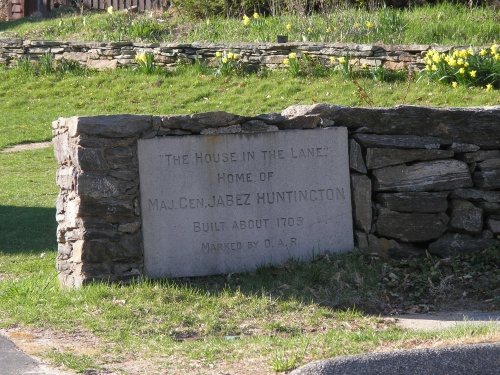
A portion of what would later be known as the Bradford-Huntington House was built in Norwich on the home lot of John Bradford sometime prior to 1691 (perhaps as early as 1660, although a D.A.R. marker on the property gives the date as 1705). The house was bought by Capt. Joshua Huntington, a merchant, in 1719 (or by his father, Simon Huntington, in 1691). In later years he would enlarge and update the house in the Georgian style, adding a gambrel roof and a new chimney. The house was later owned (1745), and expanded with the addition of a rear ell, by his son, Jabez Huntington, who became Major General of the Connecticut militia in 1776, the same year George Washington spent a night in the home during the Revolutionary War. Later, Huntington experienced mental strain from his efforts and resigned in 1779. He died in 1786 and is buried near his house in the Old Norwichtown Cemetery.

Joseph Carpenter’s Shop (1772)

joseph-carpenter-shop.jpg

Joseph Carpenter was a silversmith in Norwich whose shop, built in 1772, still stands on East Town Street, on Norwichtown Green. The shop, where Carpenter also made clocks, may be the only frame silversmith shop surviving in New England. The building is now owned by the Society of the Founders of Norwich and is currently used as a law office.

Today I have also added five new buildings to this blog’s sister site, Historic Buildings of Massachusetts! Please check them out!!!