
The 1901 Henry R. Hovey House, on Prospect Avenue in Hartford, is a Colonial Revival structure, featuring Georgian and Federal elements. Hovey was an employee of the Aetna Life Insurance Company.
The 1901 Henry R. Hovey House, on Prospect Avenue in Hartford, is a Colonial Revival structure, featuring Georgian and Federal elements. Hovey was an employee of the Aetna Life Insurance Company.

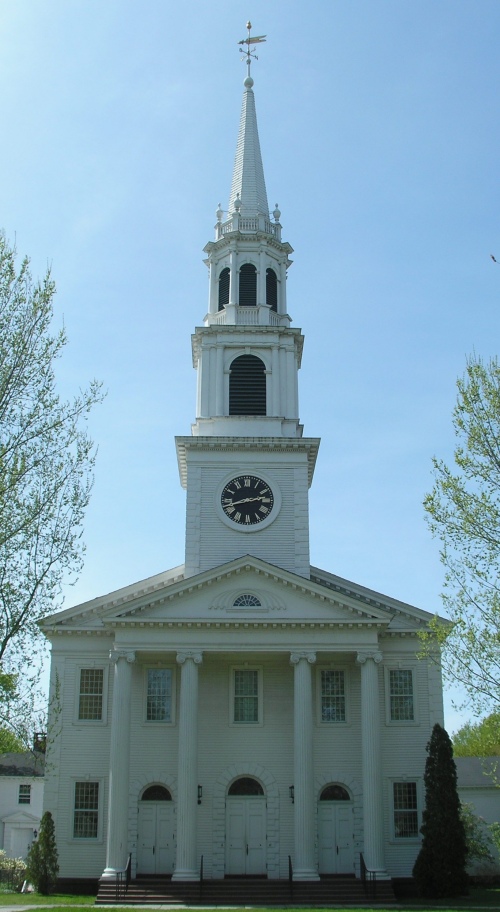
Lyme’s First Ecclesiastical Society‘s first Meeting House was constructed in 1665-6 and the first minister was Moses Noyes. A second was built in 1689 and in 1738, both earlier structures were dismantled to build the even larger third Meeting House. All three were located on Johnny Cake Hill. When the third church was destroyed after being hit by lightning in 1815, the fourth Meeting House was built in 1816-17 on Lyme Street in Old Lyme. Its architect was Samuel Belcher, who also designed the John Sill and William Noyes houses on Lyme Street. The fourth Meeting House burned on July 3, 1907–the 92nd anniversary of the burning of the third meetinghouse. It was replaced in 1910 by the current Meeting House of the First Congregational Church of Old Lyme, a replica of its predecessor. The American impressionist artists who frequented Lyme in the early twentieth century often painted the church, most notably Childe Hassam.

The Lyme artists’ colony that began with visitors to Florence Griswold’s boardinghouse eventually grew and established the Lyme Art Association in 1914. Florence Griswold gave land to the Association, next to her own house on Lyme Street, for a gallery (of which she would be the first manager). The architect of the 1921 Lyme Art Association building was Charles Adams Platt, who also designed the Freer Gallery in Washington and the Lyman Allen Museum, as well as four of the Cheney mansions in Manchester.

The home of Frank D. Cheney, of the Cheney family of silk manufacturers, is a 1902 Colonial Revival building that faces the Great Lawn in Manchester. Frank D. Cheney was the brother of Horace B. Cheney and Howell Cheney, whose houses are on either side of their brother’s mansion on Forest Street.

The Howell Cheney House is one of the mansions of the Cheney family of silk manufacturers in Manchester. Built in 1901, the house has a Forest Street address and is visible from both that street and across the Great Lawn from Hartford Road. The red brick Howell Cheney House is a Colonial Revival building, similar to the nearby Philip Cheney House, but not as symmetrical. Howell Cheney, who would serve as secretary and director of the family firm, was strongly interested in education, particularly vocational education. In 1915, he founded the Howell Cheney Technical High School in Manchester. Howell Cheney’s house is near to those of two of his brothers, Frank D Cheney and Horace Cheney. The house is currently for sale and is featured in a video on YouTube.

As Yale University expanded and acquired property along Prospect Street in New Haven, it became possible to design new campus quadrangles. The buildings of the Yale Divinity School were constructed in 1931 and designed by the architectural firm of Delano & Aldrich of New York. While based on Thomas Jefferson‘s plan for the University of Virginia, the Yale Divinity School quadrangle has much harder lines and sharper angles.

Another example of an “American Foursquare” home, the house at 1643 Boulevard in West Hartford was built around 1900 in what was the town’s first modern subdivision, begun in 1896. The area is now the Boulevard-Raymond Road Historic District. The house’s current owners won a 2007 West Hartford Historic Preservation Award for their construction of a new one-story addition to their Colonial Revival-influenced home which is compatible with the original structure and matches it seamlessly.


You must be logged in to post a comment.