The Amasa Preston House (1828)

At 152 Cornwall Avenue in Cheshire is an 1828 house, built by Amasa Preston. A settler from Wallingford, Preston was on the building committee for the Methodist Church, constructed in 1834. The house had two rooms added to the rear in 1910. Owned by the Preston and Trithall family, the house was the childhood home of architect Alice Washburn. A former high school principal in the 1890s, in 1919 Washburn began designing Colonial Revival houses in Cheshire and surrounding communities. She continued until the Great Depression forced her retirement in 1933. Around 1920, she renovated the Preston House in the Colonial Revival style, creating a beautiful front entry featuring a semicircular fan above the door. Today, the Connecticut chapter of the American Institute of Architects sponsors the annual Alice Washburn Awards for excellence in traditional house design. (more…)

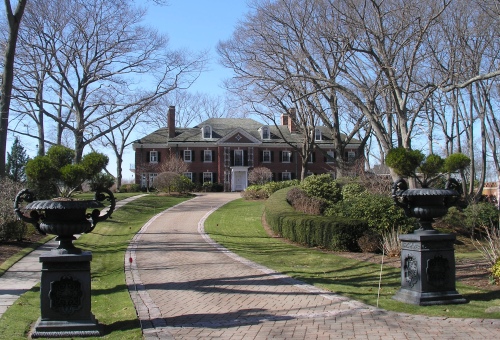
Millstreams (1917)

Millstreams is a mansion in Farmington, built in 1917 for the playwright Winchell Smith. Born in West Hartford and a graduate of Hartford Public High School, Smith was also an actor and director. He got his start in the theater company of his uncle, William Gillette, but became most known for his plays, many of which were written in collaboration with others, including Lightnin’ (1918), written with Frank Bacon, which ran for 1,291 performances. He also persuaded D.W. Griffith to film scenes from the film Way Down East, written and produced by Smith and starring Lilian Gish, in Farmington. Smith’s property in Farmington once included the old grist mill, which appears in the film, and the Gridley and Case Cottages, now owned by the Farmington Historical Society. Smith was fascinated by the Tunxis Indians and in his younger days had enjoyed camping near the Farmington River. His house was later built on Indian Neck, along a bend of the Farmington River, where it joins the Pequabuck River. Initial designs for the house were prepared by Edward T. Hapgood and completed by Cortland F. Luce after the architect’s death. At first, Smith called his estate “Lambs Gate,” because he had purchased and erected at his home the gates which had stood for many years at the entrance of the Lambs Club in New York City. Because another home in Farmington had recently been named “Old Gate,” Smith changed the name of his home to “Millstream Manor.” Smith, who died in 1933, is buried, near his home, in Riverside Cemetery. The house, surrounded by almost five acres of grounds and gardens, has recently been for sale.

Taft Hotel (1911)

Built in 1911, the Taft Hotel, on College Street in New Haven, opened its doors to the public on New Year’s Day, 1912. The elegant hotel was right near the Shubert Theater and many Broadway celebrities stayed there over the years, including Rogers and Hammerstein, who wrote the tune Oklahoma in their rooms at the Taft. Former President William Howard Taft, for whom the Hotel was named, lived there for eight years while he was teaching at Yale Law School. Before the Taft Hotel was built, other hotels and taverns had stood on the site, including one in which George Washington stayed in 1775. The Taft’s immediate predecessor was the New Haven House, designed by Henry Austin, which was built in 1858 and was razed in 1910. The Hotel closed in 1973 and was boarded while it was converted into apartments. Now known as the Taft Apartments, the building still has its historic tap room on the ground floor, restored and reopened as Richter’s Cafe in 1983. The Hotel’s grand ballroom is now a restaurant called Downtown at the Taft.

The Edwin McNeil House (1867)

The Edwin McNeil House, on North Street in Litchfield, is a good example of an older home which was transformed into a Colonial Revival edifice in keeping with the overall style of the neighborhood. The house was originally a vernacular home, built by Edwin McNeil in 1867. McNeil, a civil engineer who had served as a major in the Civil War, was instrumental in bringing the Shepaug Railroad to Litchfield in 1872. The railroad linked Litchfield to New York and spurred the town’s development as a summer resort. McNeil’s house became the Litchfield Inn in the early twentieth century and was transformed into a Colonial Revival estate after it was purchased by a wealthy Waterbury industrialist in 1911. It was renovated again in the 1990s.

Thornton Wilder House (1929)

Deepwood Drive, off Whitney Avenue in Hamden and adjacent to the town’s border with New Haven, was developed in the 1920s on on an old estate. Known architecturally for its many modern houses, the street also has older-style homes and was landscaped to have a rural appearance. Many of the homes are oriented away from the street, often obscuring them from the road. One such house, at 50 Deepwood Drive, was built in 1929 by Thornton Wilder, the Pulitzer Prize-winning playwright and novelist. Built as home for himself, his parents and sisters with the royalties from his famous novel, The Bridge of San Luis Rey (1927), Wilder referred to it as “the house the bridge built.” Wilder had a view of New Haven and East Rock from his English style country home, which sits on the edge of a promontory. He shared the house with his sister, Isabel, until he died in 1975. Thornton Wilder furniture and memorabilia from the house’s study are on display at the Miller Memorial Central Library in Hamden.