Westover School (1909)

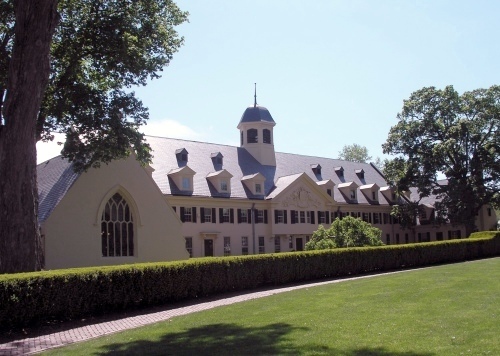
The Westover School is an independent preparatory day and boarding school for girls in Middlebury. Plans for the school’s quadrangle were completed in 1907 by Theodate Pope for Mary Hillard, Westover‘s first headmistress, who had sought to establish a school west and over the hill from Waterbury. The building was completed and opened in 1909. Designed in the Colonial Revival style, to harmonize with other structures around Middlebury Green, the Westover School building features a hexagonal cupola above the central entrance pavilion, with a Gothic chapel projecting on the east end of the structure and the cottage-like quarters of the headmistress on the west. In 1916, Theodate added Virginia House, an art and music studio, to the Westover campus.

Underledge (1896)

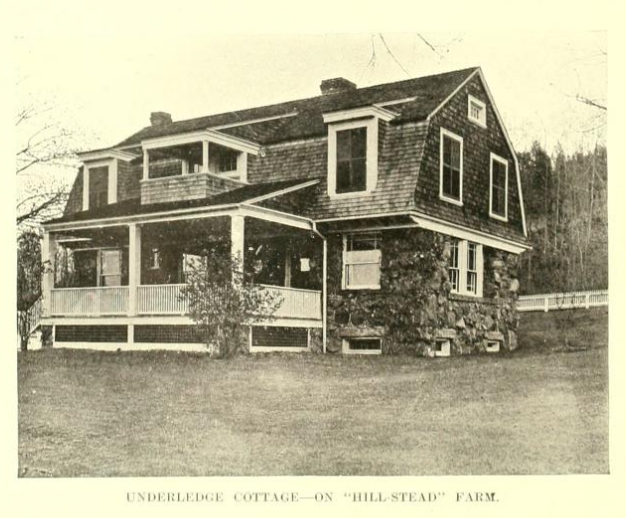
Underledge is a fieldstone cottage, built by William Potts on Mountain Road in Farmington around 1894-1896. Potts, a member of the Century Association in New York, wrote two books of nature sketches at Underledge: From a New England Hillside: Notes from Underledge (1895) and More notes from Underledge (1904). In 1898, Potts sold Underledge with eight acres to Alfred Pope and the cottage thus became part of the Hill-Stead estate. Later, Pope’s daughter, Theodate Pope Riddle, calling it the Field Office, used Underledge as her office and studio, where she planned her architectural projects. No longer part of Hill-Stead, the house is now a private home.

Plainville Public Library (1931)

A library in Plainville was founded in 1885 and occupied a series of rented rooms in commercial blocks for a number of years. In 1894, citizens voted to establish a free public library, which was at first located in the old town hall. The current library building was built in 1931 and was designed by Walter P. Crabtree. An interesting feature of the building is Colonial Revival the combination of a broken pediment and a semicircular window over the front door. The Plainville Public Library was expanded in 1962 and again in 2001-2004.

Olin Memorial Library (1928)

Rich Hall, dedicated in 1868, served as Wesleyan University‘s library until Olin Memorial Library was built in 1928. Henry Bacon, who was serving as Wesleyan’s advisory architect, made preliminary sketches for the new library in 1923, less than a year after the dedication of his most famous building, the Lincoln Memorial. Bacon died in 1924 and his ideas were passed on to the firm of McKim, Mead & White. The Library was built in 1925-1927 and dedicated in 1928. The following year, the street just south of Olin Library was moved further south to make room for a large front lawn. In anticipation of the need for future expansion of the Library, the north facade of the building, facing Andrus Field, was left unadorned and had a wall that could be easily removed. The anticipated rear expansion of the library stack area occurred in 1938. Another expansion was constructed in 1983-1986, with a modern addition cleverly designed by the firm of Perry, Dean, Rogers & Partners of Boston to wrap around and enclose the earlier expansion of 1938.

Center Congregational Church, Manchester (1904)

In 1772, the Ecclesiastical Society of Orford was established, in what would later become the town of Manchester. Owing to the unsettled conditions at the time of the Revolutionary War, it took twenty years for a Congregational meeting house to be built, although the congregation used the unfinished building for worship, starting in 1779, before it was finally completed in 1794. This first church building, which stood about 130 feet east of the present Center Church, was replaced by a new structure in 1826 on the same location. The building was raised up in 1840 so that a basement could be added below. The basement was then rented to the town for the transaction of public business. In 1878, the church’s steeple blew off and crashed through the roof. It was then sold to the town and a new church was built the following year in the Gothic style. The current church, now known as Center Congregational Church, was built in 1904 in the Colonial Revival style. The neighboring brick parish house was added in 1930 and the Simpson Educational Wing in 1957.

Congregational Church of Naugatuck (1903)

The Congregational Church of Naugatuck is on Division Street, across from Naugatuck’s Green (part of which is owned by the Church and is leased to the Borough of Naugatuck). This is the Church’s third building. The first was built on a hill to the east in 1782, a year after the congregation was formally gathered. In 1831, it was moved to a location across from the present church, on the northeast corner of what is now the Green, on land donated by Daniel Beecher, an inn keeper. It was sold and moved again, this time across the street to become a store, being replaced by the second church, built in 1853-1854. The present church was built in 1903 and was designed by the renowned architectural firm of McKim, Mead and White. It was one of several commissions by the firm around Naugatuck Green arranged by the prominent local industrialist, John Howard Whittemore.