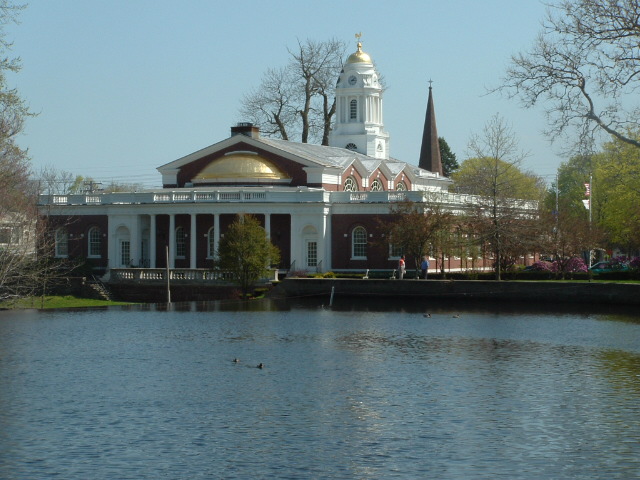
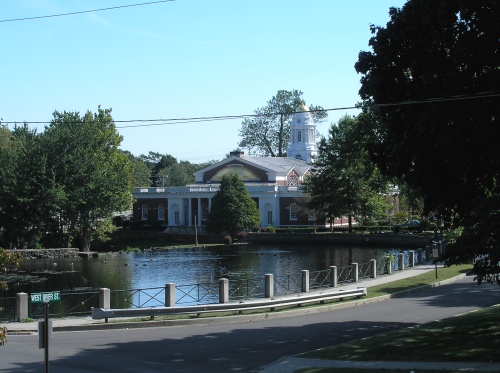
Waterbury Y.M.C.A. (1924)

A Young Men’s Christian Association was established in Waterbury in 1858. Association activities dwindled by the late 1870s, but the organization was revived in 1883 and officially incorporated in 1889, making it the oldest YMCA in Connecticut. The YMCA‘s rented space soon became inadequate and a new building was constructed on West Main Street in 1892-1893. It occupied part of what had been the land of Philo Brown, who had a house designed by Henry Austin. Philo Brown was head of the Brown and Brothers brass company. The first YMCA building was replaced in 1924 by the current Georgian Revival structure, designed by Richard Dana. The building was expanded with a new modern wing in 1971.

Agudas Achim Synagogue, Hartford (1928)

Agudas Achim is a Orthodox Jewish congregation founded in Hartford in 1887 by immigrants from Romania. Meeting at first in private homes, the Congregation moved to a building on Market Street around 1902 and then to a larger synagogue on Greenfield Street, constructed in 1928. Like the similar Beth Hamedrash Hagodol on Garden Street, Agudas Achim (1928) was designed by the firm of Berenson & Moses. Following the movement of Jews out of Hartford’s Upper Albany neighborhood, the Congregation constructed a new synagogue on North Main Street in West Hartford in 1968. The 1928 building has since been a Baptist Church and is now the Glory Chapel International Cathedral.

Harwinton Community Hall (1916)

Built in 1915-1916, Harwinton‘s Community Hall off Harwinton Green originally served as the town hall. Consisting of a brick story on a high granite ashlar foundation, this architecturally eclectic building features Greek columns and a very large Gothic pointed arch window. This structure replaced an earlier building from the 1840s, which had served as both town hall and Episcopal Church.

The Ludlow Bull House (1828)

The house at 114 North Street in Litchfield was built in 1828 by Leonard Goodwin, a trustee of the Litchfield Female Academy. Ludlow Bull purchased the house in 1925 and in 1928 he completely remodeled it as his summer home in the Colonial Revival style. Ludlow Seguine Bull (1886–1954) was an Egyptologist who started Yale’s Egyptology program and was an associate curator of Ancient Egyptian Art at the Metropolitan Museum of Art.

The Paul Hamilton House (1916)

Wilfred Griggs designed the Colonial Revival house at 98 Woodlawn Terrace in Waterbury for Paul D. Hamilton. Built in 1916, the house’s side porch was added around 1950. As described in the History of Waterbury and the Naugatuck Valley, Vol. 3 (1918), “Paul D. Hamilton, president and treasurer of the Hamilton Hardware Corporation, is thus widely known as one of the leading and representative business men of Waterbury, where his entire life has been passed and where he has so directed his efforts as to win not only success but the high and merited regard of his fellowmen.”