Beckwith Block, Litchfield (1896)

At 16 South Street in Litchfield is a commercial block, built by a member of the Beckwith family in 1896. It has served as the Litchfield Post Office since 1958. In the early 1980s, Litchfield citizens successfully fought to prevent the Post Office from moving to a large facility on the outskirts of town. $175,000 was raised to buy the building from its private owners by a partnership led by the Litchfield Preservation Trust. An additional $165,000 was then raised to remodel the building to comply with government mandates, and for architectural and legal fees. The remolded Post Office was rededicated in November, 1982.

Pierce N. Welch House (1907)

The stuccoed Colonial Revival house at 301 Prospect Street in New Haven was built in 1907 for Pierce Noble Welch. He was Yale graduate (1862) who then studied in Germany. In 1871 Welch became treasurer of the New Haven Rolling Mill Company, which his father, Harmanus M. Welch, had founded. He later became president of the company and in 1889 he succeeded his late father as president of the First National Bank of New Haven. In 1891, Welch and his two sisters donated Harmanus Welch Hall to Yale. He was also president and a director of the Bristol Brass Company, a director of the Bristol Manufacturing Company, a vice-president and director of the New Haven Gas Light Company, and a director of the New Haven Clock Company. Pierce N. Welch, born in 1841, died in Berlin, Germany in 1909. The house was acquired by Yale in 1935 and served as a dormitory and later as offices. It is currently home to the Yale School of Forestry and Environmental Studies.

Kellogg Lawn (1905)

In addition to Maxwell Court, architect Charles A. Platt designed another mansion in Rockville for a member of the Maxwell family. At 31 Union Street is the William and Alice K. Maxwell House, known as Kellogg Lawn. The house was built in 1905-1906 for Francis and William Maxwell‘s mother, Harriet K. Maxwell, widow of George Maxwell. It was built in the center of Rockville, on a site where the house of Harriet’s father, George Kellogg, had once stood. Kellogg was one of Rockville’s pioneering industrialists. Today, the mansion is part of Rockwell General Hospital, serving as an entryway to the hospital.

Maxwell Court (1904)

The Francis T. Maxwell House, at 9 North Park Street in Rockville, Vernon, is a Colonial/Classical Revival mansion, built in 1902-1904. Maxwell was a part-owner of the Hockanum Mills Company. His mansion, known as Maxwell Court, was designed by Charles Adams Platt, who was renouned as an architect and as one of America’s most influential landscape designers. Platt’s design for Maxwell Court, his first large scale project, integrates the mansion and the surrounding landscape. The house is located on a hill above the city of Rockville, near the mills but with broad views to the south and west. With its architecture, gardens and landscape, influenced by the Villa Gamberaia near Florence, the Maxwell estate was influential in the American country house movement. Maxwell Court was featured in such contemporary publications as The Country House, a Practical Manual of the Planning and Construction of the American Country Home and its Surroundings (1906), by Charles Edward Hooper and House & Garden, Vol. IV, No. 4 (October 1903)–an article whose images were reproduced in American Country Homes and their Gardens (John Cordis Baker, ed. 1906). The plan of an estate, clearly modeled on Maxwell Court, appeared in Henry Vincent Hubbard and Theodora Kimball’s An Introduction of the Study of Landscape Design (orig. pub. 1917), the principle textbook for landscape architecture courses in the United States in the early twentieth century. Today, Maxwell Court is the Rockville Elks Lodge #1359. (more…)

Frank E. Wolcott House (1924)

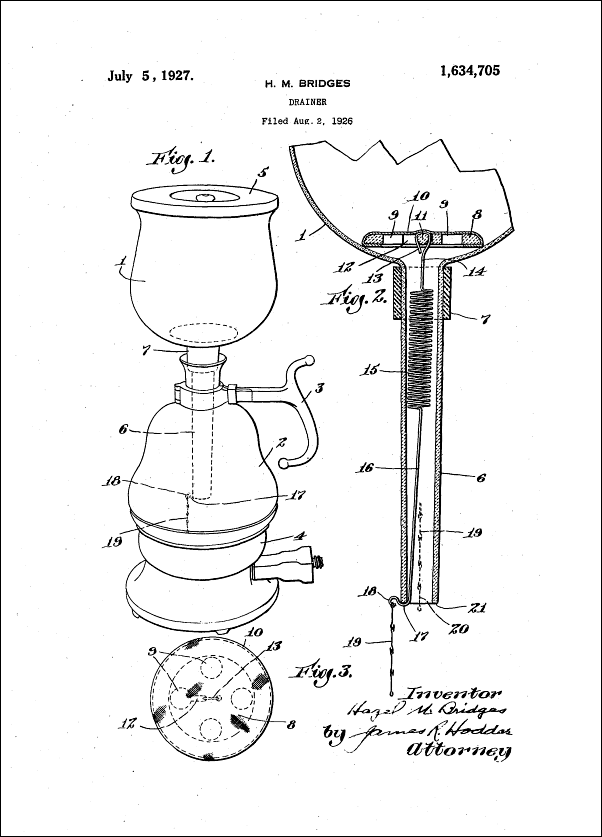
At 26 West Hill Drive, in the West Hill Historic District in West Hartford, is a Colonial/Tudor Revival house, built in 1924 and designed by Smith & Bassette for Frank E. Wolcott. His manufacturing company produced the Silex coffee pot. A vacuum brewer, the Silex coffee pot, utilizing heatproof Pyrex glass, was first produced in 1915. The rights to its design, which originated in Europe, had been acquired in 1909 by two sisters, Mrs. Ann Bridges and Mrs. Sutton, of Salem, Massachusetts. Wolcott’s company was later renamed the Silex Company. Its first patent for a coffee pot was assigned to Hazel M. Bridges in 1926. Frank E. Wolcott filed additional patents in the 1930s.

Emanuel Synagogue (1927)

Formed in 1919, Emanuel Synagogue in Hartford was Connecticut’s first Conservative congregation. In 1920, members dedicated its first synagogue in the former North Methodist Church on Main Street. With a growing membership, the congregation purchased farmland on Woodland Street in Hartford’s Upper Albany neighborhood. A new synagogue, designed by Ebbets and Frid, was completed in 1927. Emanuel Synagogue’s cemetery is located on Jordan Lane in Wethersfield. By the 1950s, with many Emanuel members having moved to West Hartford, the synagogue purchased land on Mohegan Drive and built a social hall and religious school there in 1959. Services continued to be held at Woodland Street until 1968. A new Emanuel Synagogue was completed on Mohegan Drive in 1970. The former Hartford synagogue is now Faith Seventh Day Adventist Church.