
The Colonial Revival house at 92 Prospect Street in Waterbury was built around 1917 for Martha (b. 1863) and Helen (b. 1878) Driggs, daughters of Theodore Driggs, president of the American Pin Company. The architects were Murphy & Dana of New York.
The Colonial Revival house at 92 Prospect Street in Waterbury was built around 1917 for Martha (b. 1863) and Helen (b. 1878) Driggs, daughters of Theodore Driggs, president of the American Pin Company. The architects were Murphy & Dana of New York.

The Loomis School in Windsor, later to become Loomis-Chaffee, was founded by five Loomis siblings who had all lost their own children. In the 1910s, the firm of Murphy & Dana of New York created a plan for the school‘s campus that would feature a symmetrical quadrangle and covered walkways, reminiscent of Thomas Jefferson’s plan for the University of Virginia. Anchoring the quadrangle is the centerpiece of the Georgian Revival-style campus: Founders Hall, completed in 1916. The building, which originally contained the school’s entire academic program, also houses Founders Chapel.

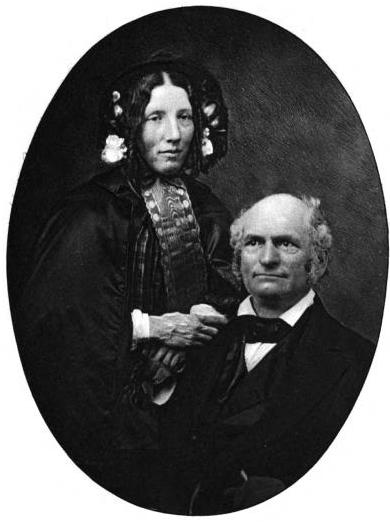
Author Harriet Beecher Stowe (1811-1896) and her husband, Calvin Stowe (1802-1886), had twin daughters named Harriet (Hattie) Beecher (1836-1907) and Eliza Tyler (1836-1912) Stowe. Neither twin married, but they lived with their parents, traveling with their mother and managing the family’s households in Hartford and in Mandarin, Florida. After their mother’s death in 1896, the twins settled in Simsbury, where their brother, Charles E. Stowe, was the minister at the First Church of Christ. According to the new Images of America series book on Simsbury, their former house at 965 Hopmeadow Street was provided for them by their brother when he became minister in 1891. They wouldn’t have moved there until their mother died, so perhaps the house was built in 1891? Today, the house is used for offices.
Update 4/5/12: There’s a new article about the Stowe family’s connections with Simsbury. Check it out!

One of the houses in West Hartford’s West Hill development of the 1920s is the Horace R. Grant House, designed by Cortland Luce and built in 1923. Horace R. Grant, President of the Allen Manufacturing Company, is credited with conceiving the idea for the development. He planned it with Stanley K. Dimock, who had inherited the land from his father, Ira Dimock, a silk manufacturer. Ira Dimock had purchased the former Vanderbilt Mansion on the property, which was later demolished to make way for the new houses. The Grant House has a rear addition, dating to 1937 and designed by William T. Marchant.

One of the houses that will be featured in tomorrow’s Mark Twain House & Museum Holiday House Tour is located at 164 Oxford Street in Hartford. It was built for an Allen of Sage Allen Department Stores in 1915. Augusta R. Roemer, a resident of the house, was a department president in the Woman’s Relief Corps in 1940-1941. Its present owners are known for their elaborate Christmas decorations, including over 60 themed Christmas trees.

This coming Sunday, December 4, will be the 31st Annual Mark Twain House & Museum Holiday House Tour, presented by the Friends of the Mark Twain House & Museum. One of the houses that will be featured on the tour is a brick Georgian Colonial at 191 Terry Road in Hartford. Built in 1923, it was designed by William T. Marchant, who was also the architect of many other Colonial Revival buildings in the area, including the Alfred C. Fuller and Wallace Stevens Houses in Hartford, the Wood Memorial Library in South Windsor and the old Hall High School, now the Town Hall, in West Hartford.

The house at 127 Oxford Street in Hartford was built in 1894 for James B. Cone, a Director of the Hartford Carpet Comany and of the Aetna National Bank. The house, designed by Frederick Royal Comstock, was featured in an article, titled “A New England Residence,” in the October 1897 issue of Carpentry and Building. According to the article:
The treatment of the exterior is such as to give a rich and harmonious effect to the design, while the rooms are arranged with a view to the convenience and comfort of the occupants. A feature which will strike many as all essential in a building of this character is a broad piazza extending across the front of the house.
Some of the house’s exterior decoration has been altered over the years, while inside some of the rooms have been combined to create larger spaces. The house was also later expanded with an addition to the south with a corresponding extension of the front piazza. The house will be part of this year’s Mark Twain House & Museum Annual Holiday House Tour, on Sunday, December 4th, 2011.
You must be logged in to post a comment.