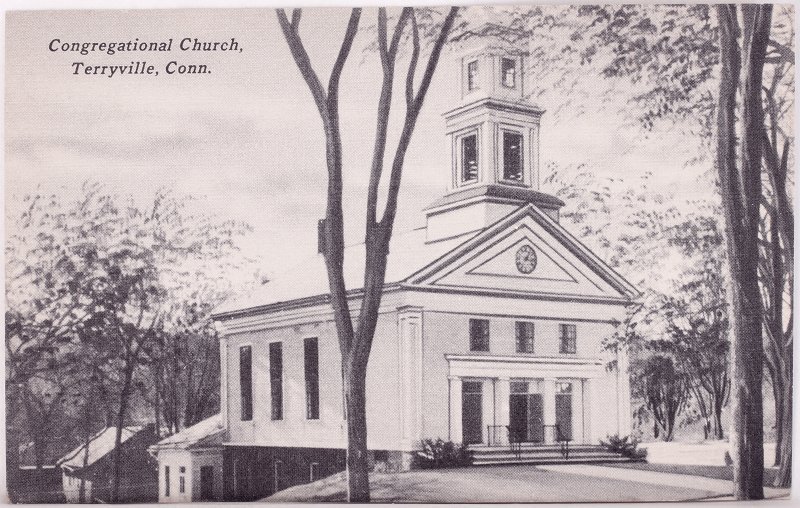
Terryville Congregational Church (1970)

Terryville Congregational Church

In 1838, members of the Plymouth Congregational Church who wanted to have a church that was closer to the industrial area of Terryville formed the new Terryville Congregational Church. Clock maker Eli Terry, Sr. was a member and he donated the clock which he manufactured for the front facade of the church. The church was destroyed by fire in 1967 and the current Terryville Congregational Church, rebuilt on the same location (233 Main Street), was dedicated on October 18, 1970. (more…)

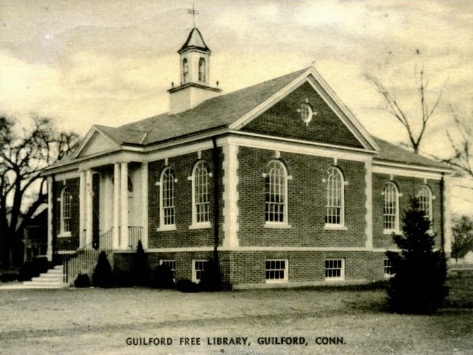
Guilford Free Library (1933)

Guilford Free Library

The Guilford Free Library, at 67 Park Street in Guilford, was built in 1933 on land donated by Frederick Spencer (he had originally bought the land, which was near his home, in order to move a feed, grain and coal store from the property because the noise was bothering his wife!). Architect Archer Quick designed the Colonial Revival building to fit in with the historic architecture of the neighborhood. Many residents objected to a plan to replace it with a modern building in the 1970s. An addition was later built, designed by Gilbert Switzer and John Matthew of New Haven. The entrance to the library was moved to the addition and the front stairs and door of the original building were replaced with a large window and balcony.

John Treadwell Norton House (1832)

John Treadwell Norton House

Born in Farmington in 1795, John Treadwell Norton (d. 1869) became successful in the hardware business in Albany, New York. Treadwelll, who had been a surveyor and engineer for the Erie Canal, returned to Farnmington to construct a feeder canal that would supply water to the Farmington Canal from the Farmington River in Unionville. On land inherited in 1824 from his grandfather, he built a Georgian-style mansion at 11 Mountain Spring Road in Farmington in 1832, where he lived as a gentleman farmer. The house of his grandfather, John Treadwell (1745-1823), who served as Governor of Connecticut, had been a station on the Underground Railroad. John Treadwell Norton was also an abolitionist. He was one of the first people to visit the Amistad captives who were confined in a jail in New Haven. He played a major role in bringing the captives to Farmington, where they lived for 8 months before returning to Africa. The property was later owned by Austin Dunham Barney and was called the Barney House. For a time, the house was a used as a conference center and bed and breakfast by the University of Connecticut. In 2001, it was sold to its current owners, who have returned to calling the house its original name of Glenbrook.