
On West Main Street in the village of Baltic is a former town hall for the town of Sprague. A brick structure in the Colonial Revival style, it was built in 1911. The current Town Hall, built in 1955, is located at 1 Main Street. (more…)
On West Main Street in the village of Baltic is a former town hall for the town of Sprague. A brick structure in the Colonial Revival style, it was built in 1911. The current Town Hall, built in 1955, is located at 1 Main Street. (more…)

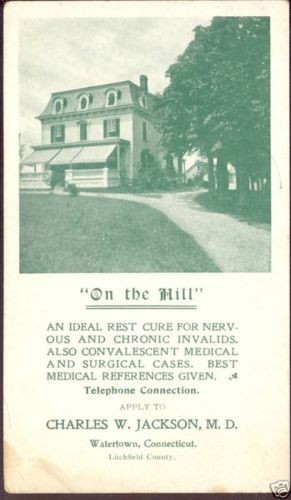
The Georgian/Colonial Revival mansion at 325 Woodbury Road in Watertown was built in 1926 for Theodore Lilley, son of Connecticut Governor George L. Lilley, who served from January 6 until April 21, 1909, when he died in office. The land for the house was purchased from Dr. Charles W. Jackson, who ran a sanatorium on Hamilton Avenue. Theodore Lilley (1888-1967), a graduate of Yale who became a developer in Waterbury, was married to Sylvia Page Lilley (1890-1970). The house has recently been restored.

The Bristol Public Library first opened in 1892 in cramped quarters in a building on Main Street. In 1896 it moved to the Charles Treadway house at the corner of Main and High Streets. On this site a new library was built in 1906 and dedicated the following year. A Colonial Revival building, it was designed by Wilson Potter of New York, who specialized in academic buildings. A Children’s Library wing and an Auditorium were later added on the north side of the building, but these were razed in 2006 for a new addition, which better reflects the original Colonial Revival architecture.

The first Catholic parish in Wethersfield was Sacred Heart parish, organized in 1876. In August of 1938, the parish’s church on Hartford Avenue was devastated by fire. Rev. George M. Grady, pastor of Sacred Heart, soon purchased an extensive tract of land on the Silas Deane Highway for the construction of a new church. Many parishioners assumed that the new church was to replace the one lost in the fire, but it was decided to make the new building a mission church of Sacred Heart. Named Corpus Christi, the new church was designed by architect John J. McMahon (1875-1958) in the Georgian Revival style to reflect Wethersfield’s colonial background. It is built of Harvard red brick with limestone trim. The church was dedicated on November 26, 1939 and Corpus Christi was officially established as a separate parish on September 27, 1941.
In July of that same year, the church’s pastor, Rev. Patrick T. Quinian, received a letter from Bishop Ambrose Pinger of Shantung (now Shandong), China. A photograph of the Wethersfield church in the Catholic Directory of 1941 had captured the bishop’s imagination and he asked to be sent plans for the church so that its design might be copied for the new cathedral in Chowtsun (now Zhoucun)!

Covenant Congregational Church in West Hartford began as the Swedish Zion Congregational Church, established in Hartford’s Frog Hollow neighborhood in 1889. The congregation’s first church building was constructed on Hungerford Street in 1892. Its name was changed to Covenant Congregational Church in 1938. Covenant Congregational Church later moved to West Hartford, laying the cornerstone to its present church on April 24, 1960. Located at the intersection of Sedgwick Road and Westminster Drive, the church was designed by Painchaud and Ryder of Madison, Wisconsin and was built by Bartlett, Brainard & Eacott of West Hartford. The building was dedicated on October 16, 1960. The church, which is Lutheran in theology and Congregational in organization, is affiliated with the Evangelical Covenant Church.

Social Society Frohsinn, a German heritage club, was founded in the first decade of the twentieth century by German weavers employed by the Rossie Velvet Mill in Mystic. Frohsinn Hall, at 54 Greenmanville Avenue, was built in 1906, just a few years after the mill. It has a bar upstairs and a hall on the first floor. Over a century later, the building is still used for its original purpose, with some current members being the descendants of the first mill employees.

The house at 24 Cone Street in Hartford’s West End was constructed in 1915. The house was designed by architect Russell F. Barker (1873-1961), who designed many other residences in the area. Early in his career, Barker had worked for George Keller and later for William, H. Scoville. (more…)
You must be logged in to post a comment.