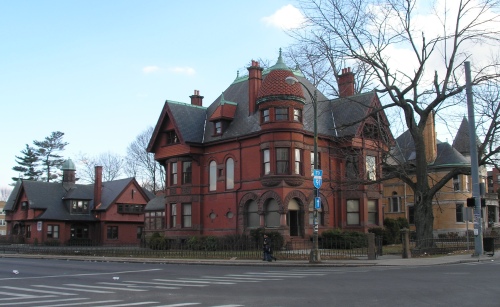
Built in 1893, on Wethersfield Avenue in Hartford for Mary Borden Munsill, the daughter of Gail Borden, who had invented condensed milk and founded Borden Milk Products. The house has an irregular Queen Anne design, with many elaborate features. The stone arches also reflect the influence of the Richardsonian Romanesque style.
Mary Rowell Storrs House (1899)
Built in 1899, on Farmington Avenue in Hartford, for Mrs. Mary Rowell Storrs, the widow of Zalmon A. Storrs, a treasurer at Society for Savings Bank. The house was designed by the prolific Hartford architect, Isaac A. Allen, Jr. The Harriet Beecher Stowe Center Library has blueprints of Allen’s original drawings for the house, as well as reminiscences of growing up there, written by Mrs. Storrs’ grandson, Lewis A. Storrs, Jr. The house was constructed in the Queen Anne style, which was becoming dated at the time (compare it with Immanuel Church, just next door, completed in the same year). The house is currently the home of the Hartford Children’s Theatre.
Col. Charles H. Northam House (1875)
Built in 1875, on Charter Oak Place in Hartford, for Colonel Charles Harvey Northam, a merchant and banker, just six years before he died. Northam was a philanthropist, who donated the Northam Memorial Chapel at Hartford’s Cedar Hill Cemetery and Northam Towers at Trinity College. The Northam House, with variety of its detailing, is an exemplar of the Queen Anne style of architecture. It has also been described as representative of the “stick style.” With its striking, historically accurate colors, the house is known locally as “The Painted Lady.”
The Hezekiah Spencer House (1820)

Built in 1820 for Hezekiah Spencer on South Main Street in Suffield. The house was later occupied early in the twentieth century by Annie Mearkle, who wrote poetry under the name Angela Marco. (more…)
The Matthew Sadd House (1750)
Built in 1750 by the carpenter, Matthew Sadd, on Main Street in East Windsor Hill, on what had been the original land grant of Maj. John Mason in the seventeenth century. The house was originally built as a saltbox, instead of having a lean-to added later. Sadd sold it to his cousin, Abiel Grant, in 1753. Both men later worked on the building of the Ebenezer Grant House. The Sadd House was later owned by Elisha Bissell, a surveyor. It was passed down in the Bissell family until it was purchased by Dudlex Clapp in 1914. He then built and lived in a house next door, leaving the Sadd House unoccupied.
The Dr. William Pierson House (1807)
Built by the Ellsworth family around 1807, the Pierson House is on Palisado Avenue in Windsor, across from the Green. The house was purchased in 1819 by Dr. William S. Pierson. Today it is owned by the First Church in Windsor.
Silas W. Robbins House (1873)
Silas Webster Robbins, a partner in the seed business, Johnson, Robbins and Co., built an impressive Second Empire style mansion on Broad Street Green in Wethersfield in 1873. Damaged by fire in 1996, the home was purchased in 2001 by new owners, who have restored it. The Silas W. Robbins House will open as a bed-and-breakfast on November 1, and a number of gala events are planned for this month, including daily house tours, Oct. 6-Oct. 14, to benefit the Keane Foundation.
You must be logged in to post a comment.