
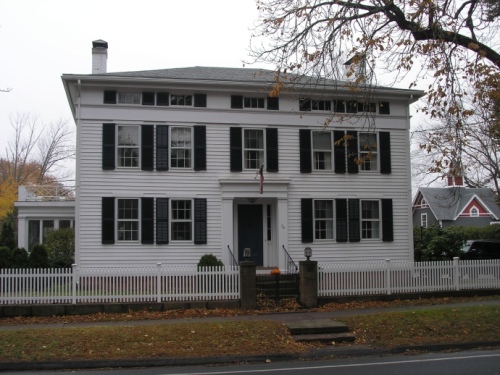
The 1799 house of Capt. Charles Francis, Jr. of Wethersfield is located on Hartford Ave. Wethersfield’s Cove Park lies behind the house, which now serves as the Wethersfield Cove Yacht Club.
The 1799 house of Capt. Charles Francis, Jr. of Wethersfield is located on Hartford Ave. Wethersfield’s Cove Park lies behind the house, which now serves as the Wethersfield Cove Yacht Club.

The Cheney School house of 1859 was originally located on a hill, west of Pine Street and north of Cooper Hill Street, in Manchester. In 1914, it was moved to its current location, on Cedar Street, by the Cheney Brothers Silk Manufacturing Company to make room for a new dye house. Over the years, the building has served as a day care center, storage space and a children’s museum. In 1985, it became the Museum of Local History, now known as the Old Manchester Museum, managed by the Manchester Historical Society. Another notable schoolhouse nearby is the 1975 replica of the original 1751 one-room Keeney Schoolhouse, located on the grounds of the Cheney Homestead.

Dr. Elisha Noyes Sill served in the Revolutionary War and was a town clerk of Windsor and a member of the Connecticut General Assembly. His house, built in 1800, is located in Windsor on Palisado Ave. Dr. Sill was the grandfather of Edward Rowland Sill, a nineteenth-century poet and educator. The Sill property also has a historic barn.

Nehemiah Street, a tailor, built his house on Main Street in Farmington in 1769. He was robbed and killed in 1791 in Niagara Falls, where he had driven cattle to sell. In 1829, his house was bought by Leonard Winship, a cabinet maker, who updated the house in the Greek Revival style, altering the roof and adding the attic windows.

The 1898 house of Gilbert W. Chapin stands on Farmington Avenue in Hartford, adjacent to the home of Mary Rowell Storrs, widow of Zalmon Storrs who, like Chapin, worked at the Society for Savings. The Chapin House, now used for offices, was designed in the Georgian Revival style by Ernest Flagg. It is less monumental than his plan for the nearby Immanuel Church, built a year later.

Hartford’s Unitarian Congregational Society began in 1844 and their first church building, built in 1846, was located at the corner of Trumbull & Asylum Streets (it was later moved to the site of the current Trinity Episcopal Church). Their second building, constructed on Pratt Street in 1881, was known as Unity Hall and also served as a lecture and concert hall. Their third church was built in 1924 on Pearl Street. In 1962, the congregation sold that building and in 1964 a new meetinghouse was dedicated. Located on Bloomfield Avenue, the Meetinghouse of the Unitarian Society of Hartford was designed by Victor Lundy. It is a very modern and abstract design, whose nonidentical supporting piers rise towards the same point in the sky, represent the Unitarian principle of many paths leading to Truth.

Kimberly Mansion, on Main Street in Glastonbury, was built sometime in the early eighteenth century by Eleazer Kimberly, a Secretary of the Connecticut Colony. It was purchased in 1790 by Zephaniah Smith, a former Sandemanian minister, who had become a lawyer. He added an addition to the house, with a separate entrance, to serve as his law office. He and his wife, Hannah Hickok , an amateur mathematician and poet, would raise five talented daughters in the house: Hancy, an inventor; Laurilla, an artist; Cyrinthia, a poet; and Julia and Abby, who would become famous political activists in the nineteenth century. Julia was also a scholar who, in 1876, published the first translation of the Bible into English by a woman.
Although they were involved, together with their mother, in Abolitionism in the years before the Civil War, Julia and Abby Smith became known throughout the country in the early 1870s for their stand against the unfair assessment of their land by the Glastonbury tax collector. By this time, the two unmarried elderly sisters were the only survivors of their family and owned the most valuable property in town, but as women they could not vote and so were taxed without representation. They therefore refused to pay taxes until they were granted a say in the use of their money. The tax man then seized and auctioned off their cows to pay the taxes. This incident, and other confrontations that followed, were extensively covered in contemporary newspapers and the sisters became prominent in Women’s Suffrage circles. After two years of legal wrangling, they would eventually win a court judgment in 1876, but not the vote. After Abby’s death, Julia finally married and moved to New Hampshire, at the age of 87!


You must be logged in to post a comment.