Cowles-Smith House (1836)

The Cowles-Smith House, at 536 Main Street in New Hartford, was built by Captain Henry Cowles in 1836. A blacksmith’s shop had once stood on the site, part of the grounds of a hotel, inherited by Henry Cowles from his father, Theodore Cowles. After experiencing financial reverses around 1840, Henry Cowles became proprietor of another hotel in Hartford, where he died in 1843. His widow and daughter then returned to New Hartford and occupied the old house until it was sold, in 1845, to John Cotton Smith. An entrepreneur, John C. Smith joined with his brother, Darius B. Smith, to establish the D.B. Smith & Sons cotton mill in Pine Meadow. He was also the agent of the Greenwoods Manufacturing Company. After his death in 1870, his widow continued to live in the house for many years. It is currently used for offices.

Westover School (1909)

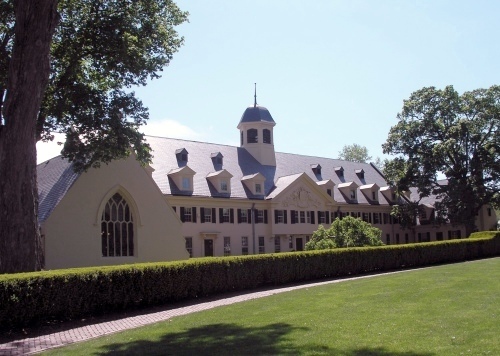
The Westover School is an independent preparatory day and boarding school for girls in Middlebury. Plans for the school’s quadrangle were completed in 1907 by Theodate Pope for Mary Hillard, Westover‘s first headmistress, who had sought to establish a school west and over the hill from Waterbury. The building was completed and opened in 1909. Designed in the Colonial Revival style, to harmonize with other structures around Middlebury Green, the Westover School building features a hexagonal cupola above the central entrance pavilion, with a Gothic chapel projecting on the east end of the structure and the cottage-like quarters of the headmistress on the west. In 1916, Theodate added Virginia House, an art and music studio, to the Westover campus.

Lavinia L. Parmly House (1890)

The Parmly House, in the Marina Park district of Bridgeport, was originally built in 1890 by Lavinia L. Parmly, a wealthy New York widow. She used it as a summer home and, upon her death in 1894, bequeathed it to her grandson, Parmly S. Clapp, as a wedding present. He later became a New York City stockbroker. The house was later purchased by Allen W. Paige, whose widow, Elizabeth, donated it to the University of Bridgeport in 1950. Named Cortright Hall, in honor of E. Everett Cortright, first president of the Junior College of Connecticut (now the University of Bridgeport). Used at first as administrative offices, Cortright Hall now houses the Department of Public Relations.

Congregational Church of Burlington (1836)

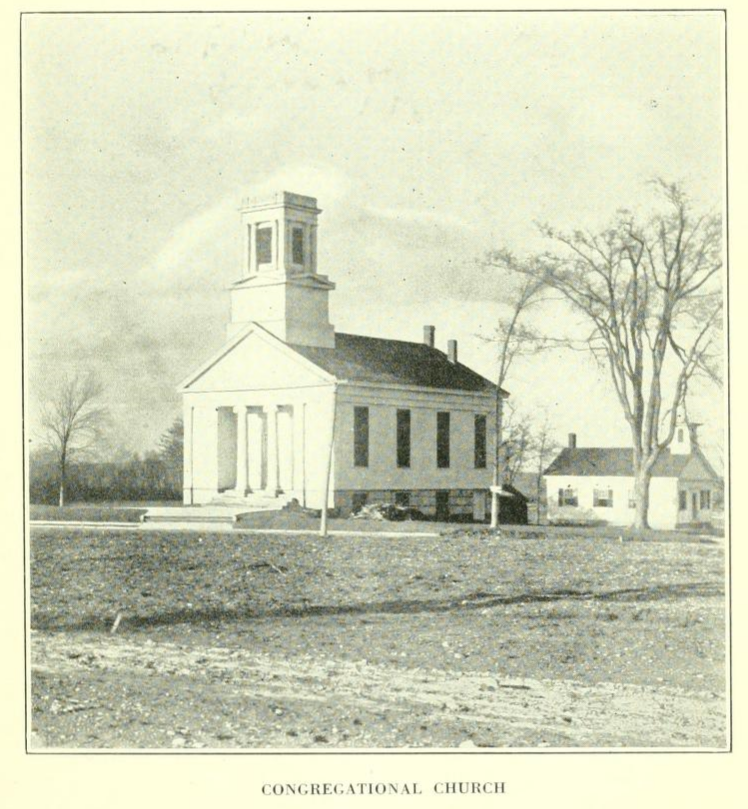
In the eighteenth century, two parishes were established in what was then the West Woods section of Farmington: the New Cambridge Ecclesiastical Society in 1742 and the West Britain Ecclesiastical Society, gathered in 1774 and incorporated in 1783. That same year, the West Britain Society dedicated their meeting house, constructed after several years of contention over where to build it. The two parishes of West Britain and New Cambridge joined in 1785 to form the new town of Bristol, but differences between the two parishes later led to the separation of West Britain as the town of Burlington in 1806. The first meeting house had been outgrown by then. According to Epaphroditus Peck, in a 1906 Address on the history of Burlington, “It is said that this little meeting-house was never finished inside, and that the swallows used to make their nests in the rafters and often fly in and out during service.” A new meeting house was built in 1809, near to the site of the first building which, according to Peck, “was removed to Bristol, and used as a cotton-mill. It afterward became the Ingraham clock-case shop, and was destroyed by fire in December, 1904.” The 1809 Congregational Church of Burlington was moved, reduced somewhat in size, and rebuilt in the Greek Revival style at its current location on the Burlington Green in 1836.

The Trowbridge-Thoms House (1830)

The Trowbridge-Thoms House, on West Street in Litchfield, was built in 1830 by Henry Trowbridge, a tanner. In the early twentieth century, the barn on the property was used as a classroom for students of landscape painter Alexander Van Lear. The house and barn remained in the Trowbridge family until 1927, when they were sold to a Mr. Thoms, who open a restaurant, called the Canteen, in the barn. The restaurant served patrons of a nearby community playhouse that was later replaced by the current town hall building. Floyd Thoms later turned the barn into an antiques shop, which was continued by the next owner, Thomas McBride, who acquired the property in 1965. Mr. McBride is now retiring and the house and antiques will be sold in an on-site auction on June 5.