Susan and Augustus Ward House (1862)

Ward

Seth Cowles (1763-1842), together with his four brothers, was a successful merchant in Farmington. When he died in 1842, his daughter Susan Cowles (1815-1894) inherited his homelot on Main Street in Farmington. Susan and her husband, Augustus Ward (1811-1883), originally from Massachusetts, removed the existing house and replaced it with the current residence, at 56 Main Street, around 1842. As related in Farmington, Connecticut, the Village of Beautiful Homes (1906):

Augustus Ward was born December 4, 1811. and died April 6, 1883. son of Comfort and Plumea Ward. He was a merchant in New Britain in its earlier days. Marrying a daughter of Mr. Seth Cowles in 1840, he removed to this village and built a new house on the site of the old Cowles mansion. He was a farmer, but had much to do with the Farmington Savings Bank after its organization in 1851, being one of its most able and efficient directors.

In 1891, Susan Cowles Ward sold the house to Henry R. Hatch of Ohio. Within a few days he sold it to Sarah Porter, headmistress of Miss Porter’s School. The house has been owned by the school ever since and is a dormitory called “Ward.” An addition was built in 1902. (more…)

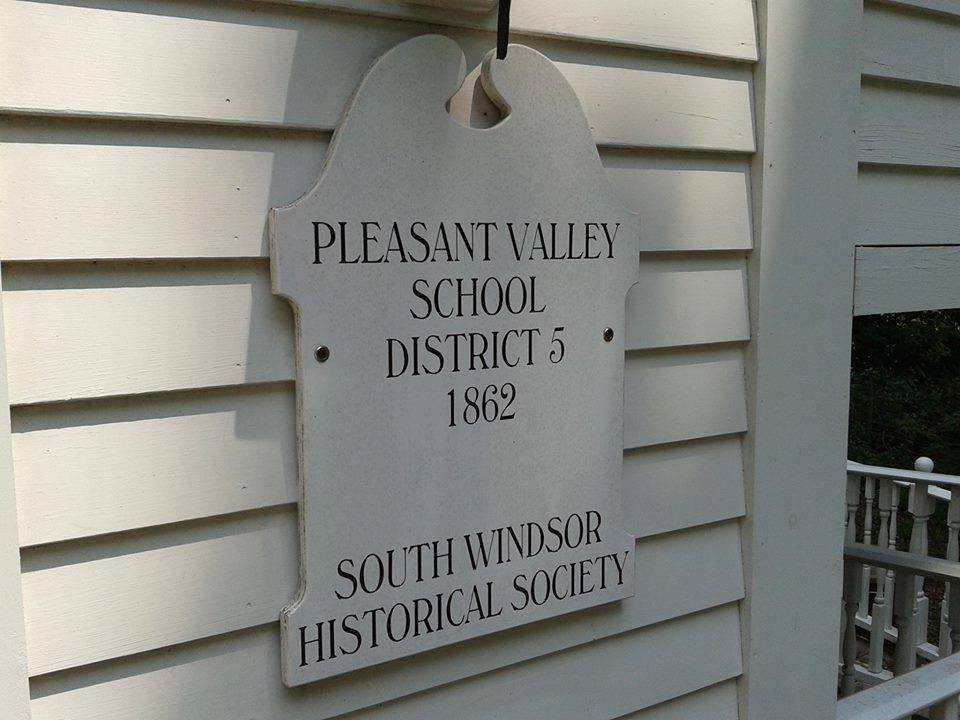
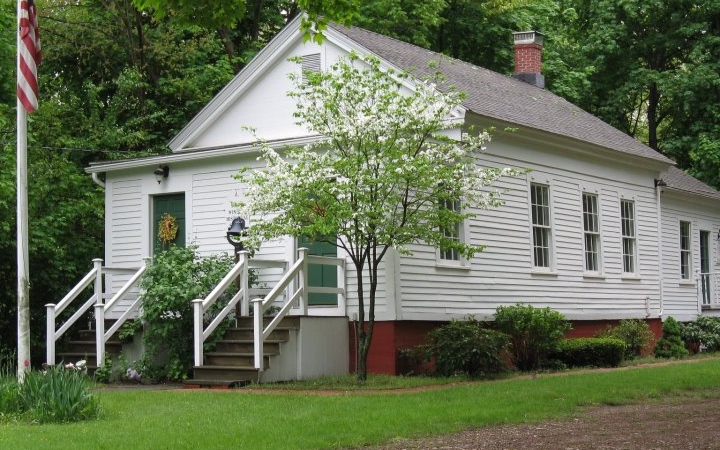
Pleasant Valley Schoolhouse (1862)

Pleasant Valley Schoolhouse

Pleasant Valley District #5 Schoolhouse, at 771 Elington Road in South Windsor, is a former one-room schoolhouse built in 1862. It replaced an earlier school that had been built on the north side of Ellington Road in 1837. In use as a school until 1952, the building was later renovated and expanded to serve as a museum of town history by the South Windsor Historical Society. (more…)

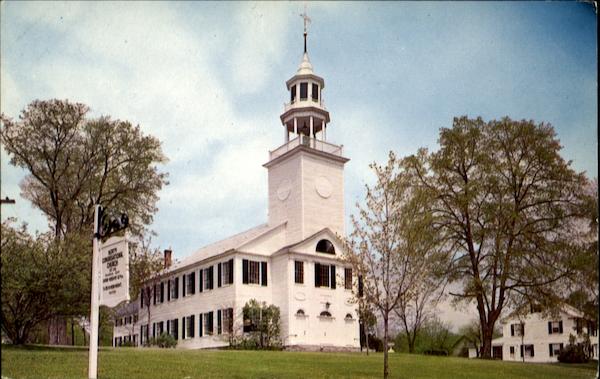
North Congregational Church, Woodbury (1816)

North Congregational Church, Woodbury

Woodbury‘s North Congregational Church was built by the Strict Congregational Society, organized in 1816 by members who had left the First Congregational Church of Woodbury. Work on building the church had already begun in 1814, two years before the society was officially organized. It was completed around 1818 and was dedicated on January 7th of the following year. The sermon at the dedication was given by Rev. Lyman Beecher.

Galpin Store (1862)

Galpin Store, Worthington Ridge

The white-painted brick building at 943 (AKA 947) Worthington Ridge in Berlin was built c. 1862 by Henry N. Galpin as a general merchandise store, replacing a previous store building on the site that had been destroyed in a fire. As related in Catharine Melinda North’s History of Berlin (1916):

From the time as far back as the memory of the oldest living person goes, a prosperous store has been conducted at the stand south of the Freedom Hart place, which for many years has borne the sign of Henry N. Galpin.

Names obtained of those who have been at the head of the business here are as follows: Orrin Beckley, about 1810; Samuel Porter (died 1838, aged eighty-eight); Horace Steele & Dr. David Carpenter; Plumb & Deming, 1835; Benjamin Wilcox; S. C. Wilcox; Galpin & Loveland; Henry N. Galpin; Strickland Bros., and lastly E. E. Honiss. This store formerly carried a line of everything that the community might need, including drugs. Physicians’ prescriptions were compounded here until, by mutual agreement, H. N. Galpin surrendered his drug department to Alfred North, who, in exchange, gave up the sale of his drygoods to Mr. Galpin.

. . . . . .

Mr. Galpin was a public-spirited citizen, ready at all times to respond liberally to every good cause. He was also a man of sterling integrity, as one, who knew him well, said, she would not fear to trust him with the last cent she owned.

As described in New England Families, Genealogical and Memorial, Vol. III (1913):

Hon. Henry Norris Galpin, son of Norris Galpin, was born in the old Galpin home on the lower end of Berlin street, Berlin, December 22, 1820, died December 22, 1892. He attended the common schools and academy in his native town and at an early age began to work for a living, his father dying when he was but a boy. He began an apprenticeship in a harness maker’s shop, but found that he preferred mercantile life and entered the employ of Edward Wilcox as clerk. He continued with Mr. Wilcox and his successor in business, Samuel C. Wilcox, until after 1850 when he purchased the business and continued it successfully to the end of his life. He owned considerable real estate in the vicinity of the store building. In 1861 his building and goods were destroyed by fire, but he erected a new building and resumed business. Though partly paralyzed from the effects of a fall in 1883, he continued to manage his business.

He was one of the leading citizens of the town, a substantial and capable man of business, active and useful in town affairs. Before the civil war he was a Democrat, but he became a Republican in 1860 and continued to support that political party to the end of his life. For many years he was town auditor and in 1863-80-82 represented his town in the general assembly. He was treasurer of school district No. 5 from 1878 until he died, and was also trustee of the Selden school fund. He was one of the organizers of the Wilcox Cemetery Association and was its first president, continuing to fill that office until his death. In 1845 he was first commissioned as postmaster of Berlin and he held the office almost continuously until he died. The post office was in his store.

The Galpin Store, much altered over the years, operated as a store into the 1950s. It is now a private residence.

Frederick Belden House (1850)

Belden House

Today is the Ninth Anniversary of Historic Buildings of Connecticut! It’s been one post a day for nine years!

Frederick Belden (1818-1893) was a wealthy Norwalk merchant. C. 1850 he built the Italianate house at 75 East Avenue across from Norwalk Green. Frederick Belden married twice, first to Catherine E Gruman Belden (1822-1864) and then to Sarah E Hill Belden (1840-1911), the oldest daughter of Ebenezer Hill, a banker and founder of the Norwalk Lock Company and the Norwalk Iron Works. The Belden house is mentioned in Norwalk (1896), by Charles M. Selleck:

The Frederick Belden residence “on the green” supplanted the more ancient Grumman home, and was presided over by those to whom refinement and good breeding seemed a second nature. Mrs. Belden was gracefully dignified and of pleasing presence. Her good mother, Mrs. Gruman, who was for many years her daughter’s care, was, like her near neighbor, Mrs. Senator Thaddeus Betts, a feeling friend. Those of Miss Susan Betts’ school children who yet remain may recall how that good instructress was wont, during the noon recess on the green, to receive warm, appetizing viands, as a mid-day luncheon. She was unforgotten in the school’s generous vicinity. As the Belden children approached maturity the bright home invited the young. The second Mrs. Belden has preserved its reputation.

Most recently used as a funeral parlor, last summer the house sold for $250,000.

Dr. Orrin Hunt House (1840)

163 Hebron Rd., Bolton CT

At 163 Hebron Road in Bolton is a Greek Revival house built c. 1840. On the property is also a building that served as Bolton’s South School House until 1949. The house was built for Dr. Orrin Hunt, who is described in Genealogy of the Name and Family of Hunt (1863):

Dr. Orrin Hunt was a native of Lebanon, Conn. He was born in that part which is now the town of Columbia. He read medicine with Dr. Fuller of that place, who sustained a high reputation in his profession; and was subsequently connected with the State Institution, the Retreat for the Insane, at Hartford. Dr. Hunt enjoyed the full confidence of his distinguished teacher. Dr. Hunt located in Bolton, and was successful in medical practice, and esteemed as a citizen. He afterwards removed to Glastenbury, and there also enjoyed the reputation of a skilful [sic] and faithful doctor. He continued to be much employed in Bolton; and, after a few years, returned to that place. Dr. Hunt was taught, by affliction in his family and by protracted suffering in his own person, to mingle sympathy with his prescriptions for others; an his visits were thus rendered peculiarly welcome and soothing. An acquaintance of nearly forty years enables the writer to speak of the estimation in which he was held by his patients. They looked upon him as a friend; and the medicines administered were the more effective and beneficial from the confidence he inspired, and the fellow-feeling and kindness manifested. His Christian influence was much valued, and his death deplored as a great loss