526-534 East Washington Street, Bridgeport (1882)

Monday, May 14th, 2012 Posted in Bridgeport, Houses, Romanesque Revival | No Comments »

The 3-unit row houses at 526-534 East Washington Street, facing Washington Park, in East Bridgeport, were built in 1882 to designs by Palliser & Palliser.

Share Button

580-584 Kossuth Street, Bridgeport (1889)

Monday, April 2nd, 2012 Posted in Bridgeport, Houses, Queen Anne, Romanesque Revival | No Comments »

James Spargo was a Bridgeport housing contractor. In 1889 he built row houses at 580-4 Kossuth Street in East Bridgeport which are interesting for their combination of Queen Anne and Richadsonian Romanesque architectural features. One of the original residents of one of these houses was Rev. Henry M. Sherman, who had been rector of Calvary Church in Colchester and Trinity Church in Torrington, the latter from 1876 to 1890.

Share Button

Charles H. Russell Block (1882)

Monday, January 16th, 2012 Posted in Bridgeport, Houses, Victorian Eclectic | No Comments »

The Charles H. Russell Block, 374-384 Atlantic Street in Bridgeport, is a four-unit block of row houses built in 1882. Based on circumstantial evidence, the building has been attributed to the architectural firm of Palliser, Palliser & Company. The block is part of a planned development of working-class housing, innovatively designed by the Pallisers on land owned by P.T. Barnum.

Share Button

256-270 Broad Street, Bridgeport (1879)

Thursday, October 13th, 2011 Posted in Bridgeport, Houses, Queen Anne | 2 Comments »

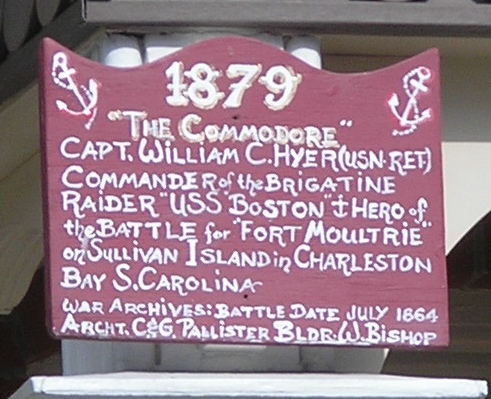
A block of brick row houses at 256-270 Broad Street in Bridgeport, which date to around 1879, have been attributed to the architectural firm of Palliser & Palliser and the builder W. Bishop. The houses combine elements of the Victorian Gothic, Queen Anne and Romanesque styles in their eclectic facades. George and Charles Palliser built a number of such brick row houses in different parts of Bridgeport in the early 1880s, but this style of urban housing did not catch on in the city. One of this row of houses has a sign out front indicating that it was the home of Capt. William C. Hyer, who commanded a brigantine in fighting in 1864 at Fort Moultrie, Sullivan’s Island, South Carolina.

Share Button

Orange Street Row Houses, New Haven (1869)

Friday, February 12th, 2010 Posted in Houses, New Haven, Second Empire | No Comments »

New Haven has a number of examples (pdf) of row houses. The connected row of Second Empire houses at 545-551 Orange Street are far more lavishly ornamented than the Middletown row houses I posted yesterday. These Orange Street houses were built in 1869-1871 by the builder Nelson Newgeon.

Share Button

Crescent Street Row Houses, Middletown (1867)

Thursday, February 11th, 2010 Posted in Houses, Middletown, Second Empire | No Comments »

Urban-style row houses are not so common in Connecticut, but a notable example can be found at 71-83 Crescent Street in Middletown. These Mansard-roofed houses were built in 1866-1867 by Julius Hotchkiss, an entrepreneur and politician, who had been mayor of Waterbury and began serving in the United States House of Representatives the year the original houses were completed. The house at #71 was built in 1895 by his daughter, M. Amelia Vinal, who had married the lawyer, Charles Green Rich Vinal.

Share Button

Park Terrace Houses (1895)

Monday, February 25th, 2008 Posted in Hartford, Houses, Queen Anne | 2 Comments »

parkterrace.JPG

This week, we will be looking at the architecture of George Keller. Born in Ireland, Keller came to the United States when he was ten. Taking up the study of architecture, he came to Hartford to design monuments for J.G. Batterson, producing many memorials for Cedar Hill Cemetery. He would later design the cemetery’s Northam Memorial Chapel in 1882. Keller utilized a Gothic style and resisted the Classical and Colonial Revivals.

Primarily associated with churches and public buildings, Keller also designed houses, so we begin this week with the row houses he designed along Park Terrace in Hartford (above). These houses present a simplified form of Keller’s “Modern Gothic” style. They also display similarities with Keller’s design for the (no longer extant) Hartford High School building of 1883. He also designed a similar group of houses along Columbia Street in 1888-1889. The Park Terrace houses had a special significance for Keller, because the last house on the row (24 Park Terrace, below) became his own home as the fee for planning the project.

georgekellershouse.JPG

Share Button