The building at 15 School Street in the Unionville section of Farmington was erected in 1917 as the town’s West End Library. Designed by Edward Tilton of New York, it was one of the many Carnegie libraries built throughout the country from the later nineteenth through the early twentieth centuries. Not used as a library since the 1960s, it has been home to the Unionville Museum since 1984.
Abner S Hart was a member of the general assembly in 1887, representing the town of Farmington in the house. Mr. Hart cast his first vote for Henry Clay for president in 1844 and has since been a member of the whig and republican parties. He was born in Barkhamsted, July 15, 1823, and received a thorough education, preparing him for the avocation of teaching in the public schools. He pursued that calling for fourteen years, teaching winters and farming through the summer. In 1866 he established himself in the drug business at Riverton and became postmaster there in 1869. The latter position was retained for twelve years. He has held various local offices, including that of acting school visitor for fourteen years and chairman of the board of relief. Since 1881 he has resided at Unionville, where he is engaged in mercantile pursuits. Mr. Hart is a member of Evening Star Lodge, No. 101, F. and A. M., of Unionville. He is descended from revolutionary stock, both of his grandfathers having served in the war for independence. He has in his possession a sword that was carried in the service by one of them. Mr. Hart is a prominent citizen of Unionville, and is held in thorough esteem in that community as well as in his old home in Barkhamsted.
Abner S. Hart had three sons with his first wife, Julia. The older two continued in business in Riverton, while the youngest, Henry, joined his father in Unionville, where Abner lived with his second wife, Margaret. Abner retired from his store, called A. S. Hart and Son, in 1896, and the business was continued by Henry under the name H. W. Hart and Company. The house remained in the Hart family until 1937. In recent years, it has had significant alterations, with a redesigned entryway and windows, a new porch, and the addition of a rooftop cupola, which is in keeping with the building’s Italianate style.
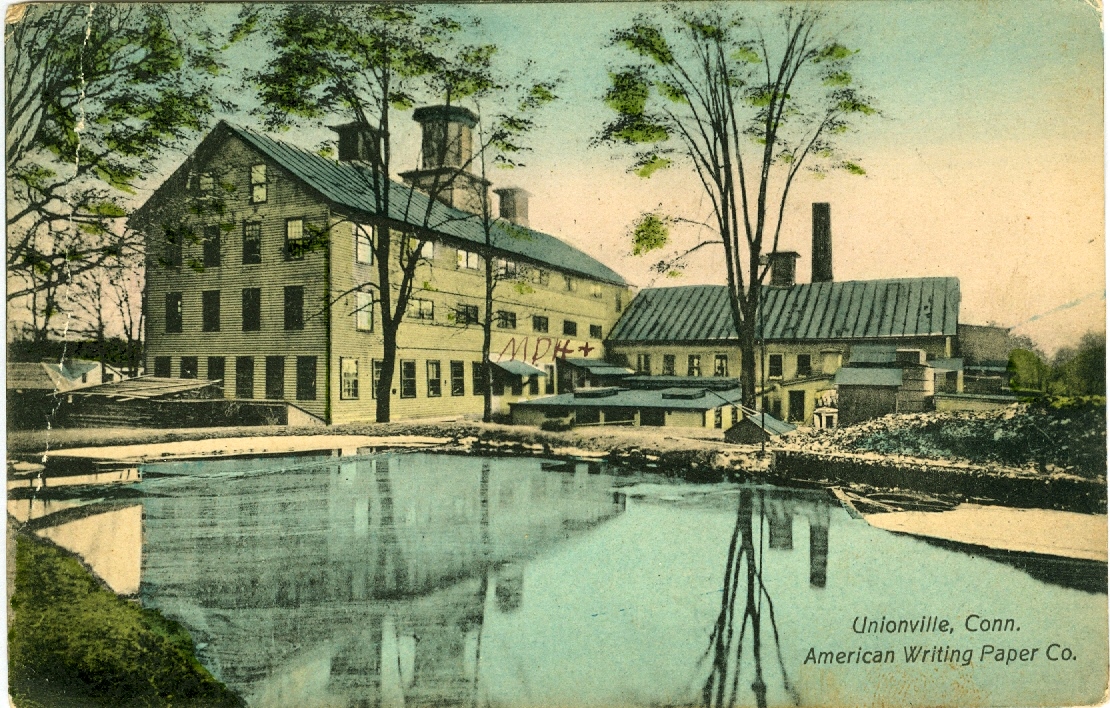
In 1848, William Planter and Samuel Q. Porter purchased the Stone and Carrington paper mill in Unionville. They soon built another mill and in 1860 organized the Planter & Porter Manufacturing Company, which produced fine writing paper and book paper. As one of Unionville’s largest employers, they needed housing for their workers and erected at least five rental houses in the neighborhood. They erected the rooming and boarding house at 28 Elm Street in 1854. Franklin C. Chamberlin, a Hartford lawyer, bought the building in 1878 and continued to rent its rooms out to local factory workers. In 1889 the house became the residence of Thomas Mulrooney, an Irish immigrant who worked at the American Writing Paper Company (which had acquired Planter & Porter in 1877), and his wife Mary Jane Mulrooney, who was born in Burlington to Irish immigrant parents. Mrs. Mulrooney rented out rooms in the house to supplement the family’s income. The house remained in the family until 1941.
In the early nineteenth century, Methodists in Unionville traveled to Burlington for services. Eventually they began to hold their own meetings in Unionville on the second floor of the Tryon and Sanford store at the intersection of Main and Lovely Streets. Unionville soon grew as a population center and a number of Methodists in Burlington eventually joined their coreligionists in Unionville to build a church on Farmington Avenue in 1867 (near the site that would later have a Friendly’s restaurant). By the 1920s, the Methodists had outgrown their church building and they erected a new one on School Street, on a site where the Solomon Richards Mansion, one of the grandest in Unionville, had been taken down in 1925. Completed the following year, the church, built by local builder John Knibbs, displays the influence of the Arts and Crafts movement. Sometimes called the “Stone Church,” it’s design was modeled on the Lake Mahopec Methodist Church in Mahopec, New York. In 1929 the church officially adopted the name of “Memorial Methodist Episcopal Church.” A parish hall to the rear was erected in 1959. Urban renewal in Unionville in the late 1960s provided the opportunity for the church, now called Memorial United Methodist Church, to relocate again, this time to West Avon Road in Avon. The former church in Unionville is now used by the Town of Farmington as a Youth Center.
Yesterday I posted a workers’ tenement building erected by Nathaniel Hayden, a Civil War veteran, in Unionville in 1875. It was one of several tenements constructed in that community in Farmington during a period of industrialization in the nineteenth century. A growing industrial labor force was being drawn to Unionville’s paper mills. Another tenement, located next door to Hayden’s, was erected by John P. Chamberlin (1823-1893), a mechanic, sometime between 1878 and 1889. Chamberlin had purchased the property from Franklin Chamberlin in 1867. The relationship between the two Chamberlins is unknown; Franklin, who had links with local paper mill owners, was a lawyer in Hartford and a neighbor of Mark Twain. The property that John P. Chamberlin acquired included a house on Main Street and land to the rear, where both he and Hayden would build tenement buildings along a passway that would become Maple Avenue. In the 1870s, Chamberlin also erected the rental house at 66 Maple Avenue. Chamberlin’s 6-tenement building, 60-64 Maple Avenue, passed out of his family in 1919.



You must be logged in to post a comment.